
Participation of Johannes Hahn, Member of the European Commission in charge of Regional Policy, at the conference on searching for growth and jobs in times of austerity measures in the EU, (EC Audiovisual Services).
 On top of that Spain and Italy are two special categories of their own. Spain had asked for official help from the European Union not to bail out its public finance but to support its ailing banks. The EU has earmarked a sum €100 billion for this purpose but the money is not lent directly to banks, but through Madrid’s exchequer. In this way the public debt of Spain has reached levels exceeding the permitted 60% and the country has been submitted to a regime similar to the three programme countries.
Then was Italy. This one is also a category by itself. Italy however is the third largest economy of the EU and its public debt nears to €2 trillion. Rome hasn’t asked for official support for its banks nor for the government sector. The size of the economy and its huge debts didn’t permit any thoughts of bailout from the rest of Eurozone, simply because there is not such a possibility. So in this case, things worked officiously, not officially. Rome was ‘convinced’ to apply an austerity programme of its own without official supervision by the troika. The country had to remain in the market to refinance its own debts at any political cost.
To make that possible the Berlusconi administration had to quit, rather pushed out, in November of 2011. Mario Monti, a respected political figure, was then sworn in as Prime minister to introduce the needed unpopular measures. He was replaced last weekend by the number two of the centre-left Democratic Party, Enrico Letta, whose government is expected later on today to be approved by the country’s two legislative bodies, the Parliament and the Senate. Letta, is expected to continue on Monti’s footsteps but probably in a less severe manner. Let’s return however to the economic power room of all political developments in Eurozone, the government deficits and debts.
Deficits and debts
The excess deficit and debt procedure entails several steps – including the possibility of sanctions – to encourage the Member State concerned to take appropriate measures to rectify the situation. “The same deficit and debt limits are also criteria for economic and monetary union (EMU) and hence for joining the euro. Furthermore, the latest revision of the integrated economic and employment guidelines (revised as part of the Europe 2020 strategy for smart, sustainable and inclusive growth) includes a guideline to ensure the quality and the sustainability of public finances”, observes Eurostat, the EU’s statistical service empowered to verify those exceedances.
Eurostat
Eurostat is closely monitoring government deficits and public debts for the entire European Union. According to this source “These statistics are crucial indicators for determining the health of a Member State’s economy and under the terms of the EU’s stability and growth pact (SGP), Member States pledged to keep their deficits and debt below certain limits: a Member State’s government deficit may not exceed -3 % of its gross domestic product (GDP), while its debt may not exceed 60 % of GDP. If a Member State does not respect these limits, the so-called excessive deficit procedure is triggered. This entails several steps – including the possibility of sanctions – to encourage the Member State concerned to take appropriate measures to rectify the situation. The same deficit and debt limits are also criteria for economic and monetary union (EMU) and hence for joining the euro.
Furthermore, the latest revision of the integrated economic and employment guidelines (revised as part of the Europe 2020 strategy for smart, sustainable and inclusive growth) includes a guideline to ensure the quality and the sustainability of public finances. The financial and economic crisis has resulted in serious challenges being posed to many European governments. The main concerns are linked to the ability of national administrations to be able to service their debt repayments, take the necessary action to ensure that their public spending is brought under control, while at the same time trying to promote economic growth”.
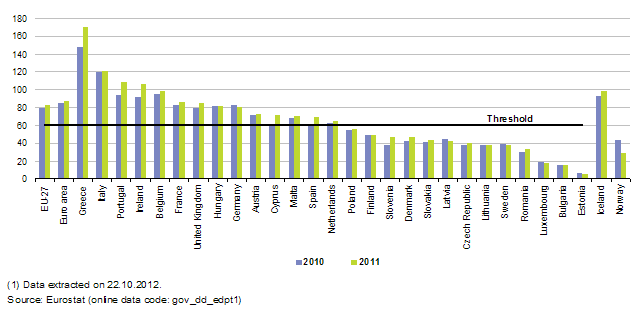
In 2011, the government deficit (net borrowing of the consolidated general government sector, as a share of GDP) of both the EU-27 and the euro area (EA-17) decreased compared with 2010, but general government debt increased. The case of Greece is very characteristic. After two revisions and an equal number of programmes drafted by the troika, the country’s debt rose from around 145% of GNP in 2010, to 170% of the GNP in 2011. And that, despite the generous reduction of budget deficits.
However the deep recession that was imposed upon Greece had also led to grave political and social problems, at times endangering the very country’s position in the Eurozone. The same policies proved to have the same devastating results for Spain. Both countries suffer now of unseen before unemployment levels of the order of 27% of the labour force and above 50% for the young workers. This past weekend the Rajoy government recognised that the applied policies lead only to further losses of incomes and employment and seem to be self-feeding a vicious cycle of austerity and recession. To reverse that Madrid announces two new programmes to stabilise and reform the economy. It’s not yet clear if those programmes constitute a breach of Spain’s obligations towards the EU.
Let’s return however to numbers. According to Eurostat “In the EU-27 the government deficit-to-GDP ratio decreased from -6.5 % in 2010 to -4.4 % in 2011, and in the euro area it decreased from -6.2 % to -4.1 %. Deficit ratios were greater than the reference threshold of -3 % of GDP in 17 of the Member States in 2011. Ten Member States had a government deficit exceeding the -3 % threshold for the whole of the reporting period 2008 to 2011. The largest government deficits (as a percentage of GDP) in 2011 were recorded by Ireland (-13.4 %), Greece (-9.4 %), Spain (-9.4 %) and the United Kingdom (-7.8 %). Twenty-five Member States saw their government deficit (in relation to GDP) reduced, or saw their government surplus expand in 2011 compared with 2010. Hungary, Estonia and Sweden registered a government surplus in 2011. There were seven Member States, namely Bulgaria, Denmark, Germany, Luxembourg, Malta, Austria and Finland which recorded deficits in 2011 that were lower than the -3 % threshold. Two Member States – Cyprus and Slovenia – recorded larger deficits in 2011 than in 2010”.
Government debt
As it is logical government deficits feed directly public debts. In the EU-27 the government debt-to-GDP ratio increased from 80.0 % at the end of 2010 to 82.5 % at the end of 2011, and in the euro area from 85.4 % to 87.3 %. A total of 14 Member States reported a debt ratio above 60 % of GDP in 2011. At the end of 2011, the lowest ratios of government debt-to-GDP were recorded in Estonia (6.1 %), Bulgaria (16.3 %) and Luxembourg (18.3 %) – see Figure 2. In 2011, government debt-to-GDP ratios increased for 21 EU Member States when compared with 2010, while government debt ratios decreased for six Member States: Germany, Estonia, Latvia, Luxembourg, Hungary and Sweden. The highest increases of debt ratios from 2010 to 2011 were observed in Greece (22.3 percentage points), Portugal (14.6 points), Ireland (14.2 points) and Cyprus (9.8 points).
Austerity questioned
Presently the entire package of austerity policies has been questioned very vividly. The fact is that as in the case of Greece, the first country to have asked for a bailout and apply severe austerity, all consolidation programmes do not seem to deliver. Year after year recession is deepening also in Spain, Italy and Portugal with the exemption of Ireland, the only country where the recipe seems to work. In view of that the IMF has asked the Eurozone decision makers, sitting mainly in Berlin, to revise the entire austerity package and accept a new haircut of over-indebted countries liabilities, starting from Greece.
As a matter of fact almost all Greek debt is now owned by public Eurozone institutions. After three debt revisions Greek obligations have nowadays been amassed by Eurozone governments, national central banks and the ECB. The Berlin government and the country’s central bank, the Bundesbank, are main owners of Greek bonds. Obviously any haircut on this debt will primarily be born by the German taxpayer. That is why Berlin strongly resists any talk for relaxation of austerity and application of some kind of growth policies, in view of the September general elections in the country.
Relaxation however gains everyday more momentum. Last week even Ollie Rehn, the European Commissioner responsible for EU’s management of the entire issue, has joined the club of ‘relaxationists’. First was Manuel Barroso, the President of the European Commission, who clearly indicated that the presently applied policy mix, containing only austerity, cannot deliver growth. Both those two Brussels dignitaries were strongly reprimanded by the Berlin government. Even Germany though has its limits and the same is true for the resistance to growth measures and the relaxation of austerity. What is needednow is a catalyst, which may be offered by a Greek success, to deliver primary fiscal surplus this year (without counting interest payments).
On top of that Spain and Italy are two special categories of their own. Spain had asked for official help from the European Union not to bail out its public finance but to support its ailing banks. The EU has earmarked a sum €100 billion for this purpose but the money is not lent directly to banks, but through Madrid’s exchequer. In this way the public debt of Spain has reached levels exceeding the permitted 60% and the country has been submitted to a regime similar to the three programme countries.
Then was Italy. This one is also a category by itself. Italy however is the third largest economy of the EU and its public debt nears to €2 trillion. Rome hasn’t asked for official support for its banks nor for the government sector. The size of the economy and its huge debts didn’t permit any thoughts of bailout from the rest of Eurozone, simply because there is not such a possibility. So in this case, things worked officiously, not officially. Rome was ‘convinced’ to apply an austerity programme of its own without official supervision by the troika. The country had to remain in the market to refinance its own debts at any political cost.
To make that possible the Berlusconi administration had to quit, rather pushed out, in November of 2011. Mario Monti, a respected political figure, was then sworn in as Prime minister to introduce the needed unpopular measures. He was replaced last weekend by the number two of the centre-left Democratic Party, Enrico Letta, whose government is expected later on today to be approved by the country’s two legislative bodies, the Parliament and the Senate. Letta, is expected to continue on Monti’s footsteps but probably in a less severe manner. Let’s return however to the economic power room of all political developments in Eurozone, the government deficits and debts.
Deficits and debts
The excess deficit and debt procedure entails several steps – including the possibility of sanctions – to encourage the Member State concerned to take appropriate measures to rectify the situation. “The same deficit and debt limits are also criteria for economic and monetary union (EMU) and hence for joining the euro. Furthermore, the latest revision of the integrated economic and employment guidelines (revised as part of the Europe 2020 strategy for smart, sustainable and inclusive growth) includes a guideline to ensure the quality and the sustainability of public finances”, observes Eurostat, the EU’s statistical service empowered to verify those exceedances.
Eurostat
Eurostat is closely monitoring government deficits and public debts for the entire European Union. According to this source “These statistics are crucial indicators for determining the health of a Member State’s economy and under the terms of the EU’s stability and growth pact (SGP), Member States pledged to keep their deficits and debt below certain limits: a Member State’s government deficit may not exceed -3 % of its gross domestic product (GDP), while its debt may not exceed 60 % of GDP. If a Member State does not respect these limits, the so-called excessive deficit procedure is triggered. This entails several steps – including the possibility of sanctions – to encourage the Member State concerned to take appropriate measures to rectify the situation. The same deficit and debt limits are also criteria for economic and monetary union (EMU) and hence for joining the euro.
Furthermore, the latest revision of the integrated economic and employment guidelines (revised as part of the Europe 2020 strategy for smart, sustainable and inclusive growth) includes a guideline to ensure the quality and the sustainability of public finances. The financial and economic crisis has resulted in serious challenges being posed to many European governments. The main concerns are linked to the ability of national administrations to be able to service their debt repayments, take the necessary action to ensure that their public spending is brought under control, while at the same time trying to promote economic growth”.
In 2011, the government deficit (net borrowing of the consolidated general government sector, as a share of GDP) of both the EU-27 and the euro area (EA-17) decreased compared with 2010, but general government debt increased. The case of Greece is very characteristic. After two revisions and an equal number of programmes drafted by the troika, the country’s debt rose from around 145% of GNP in 2010, to 170% of the GNP in 2011. And that, despite the generous reduction of budget deficits.
However the deep recession that was imposed upon Greece had also led to grave political and social problems, at times endangering the very country’s position in the Eurozone. The same policies proved to have the same devastating results for Spain. Both countries suffer now of unseen before unemployment levels of the order of 27% of the labour force and above 50% for the young workers. This past weekend the Rajoy government recognised that the applied policies lead only to further losses of incomes and employment and seem to be self-feeding a vicious cycle of austerity and recession. To reverse that Madrid announces two new programmes to stabilise and reform the economy. It’s not yet clear if those programmes constitute a breach of Spain’s obligations towards the EU.
Let’s return however to numbers. According to Eurostat “In the EU-27 the government deficit-to-GDP ratio decreased from -6.5 % in 2010 to -4.4 % in 2011, and in the euro area it decreased from -6.2 % to -4.1 %. Deficit ratios were greater than the reference threshold of -3 % of GDP in 17 of the Member States in 2011. Ten Member States had a government deficit exceeding the -3 % threshold for the whole of the reporting period 2008 to 2011. The largest government deficits (as a percentage of GDP) in 2011 were recorded by Ireland (-13.4 %), Greece (-9.4 %), Spain (-9.4 %) and the United Kingdom (-7.8 %). Twenty-five Member States saw their government deficit (in relation to GDP) reduced, or saw their government surplus expand in 2011 compared with 2010. Hungary, Estonia and Sweden registered a government surplus in 2011. There were seven Member States, namely Bulgaria, Denmark, Germany, Luxembourg, Malta, Austria and Finland which recorded deficits in 2011 that were lower than the -3 % threshold. Two Member States – Cyprus and Slovenia – recorded larger deficits in 2011 than in 2010”.
Government debt
As it is logical government deficits feed directly public debts. In the EU-27 the government debt-to-GDP ratio increased from 80.0 % at the end of 2010 to 82.5 % at the end of 2011, and in the euro area from 85.4 % to 87.3 %. A total of 14 Member States reported a debt ratio above 60 % of GDP in 2011. At the end of 2011, the lowest ratios of government debt-to-GDP were recorded in Estonia (6.1 %), Bulgaria (16.3 %) and Luxembourg (18.3 %) – see Figure 2. In 2011, government debt-to-GDP ratios increased for 21 EU Member States when compared with 2010, while government debt ratios decreased for six Member States: Germany, Estonia, Latvia, Luxembourg, Hungary and Sweden. The highest increases of debt ratios from 2010 to 2011 were observed in Greece (22.3 percentage points), Portugal (14.6 points), Ireland (14.2 points) and Cyprus (9.8 points).
Austerity questioned
Presently the entire package of austerity policies has been questioned very vividly. The fact is that as in the case of Greece, the first country to have asked for a bailout and apply severe austerity, all consolidation programmes do not seem to deliver. Year after year recession is deepening also in Spain, Italy and Portugal with the exemption of Ireland, the only country where the recipe seems to work. In view of that the IMF has asked the Eurozone decision makers, sitting mainly in Berlin, to revise the entire austerity package and accept a new haircut of over-indebted countries liabilities, starting from Greece.
As a matter of fact almost all Greek debt is now owned by public Eurozone institutions. After three debt revisions Greek obligations have nowadays been amassed by Eurozone governments, national central banks and the ECB. The Berlin government and the country’s central bank, the Bundesbank, are main owners of Greek bonds. Obviously any haircut on this debt will primarily be born by the German taxpayer. That is why Berlin strongly resists any talk for relaxation of austerity and application of some kind of growth policies, in view of the September general elections in the country.
Relaxation however gains everyday more momentum. Last week even Ollie Rehn, the European Commissioner responsible for EU’s management of the entire issue, has joined the club of ‘relaxationists’. First was Manuel Barroso, the President of the European Commission, who clearly indicated that the presently applied policy mix, containing only austerity, cannot deliver growth. Both those two Brussels dignitaries were strongly reprimanded by the Berlin government. Even Germany though has its limits and the same is true for the resistance to growth measures and the relaxation of austerity. What is needednow is a catalyst, which may be offered by a Greek success, to deliver primary fiscal surplus this year (without counting interest payments).Share this Sting:

Discover more from The European Sting - Critical News & Insights on European Politics, Economy, Foreign Affairs, Business & Technology - europeansting.com
Subscribe to get the latest posts sent to your email.





Why don't you drop your comment here?