Upgrading Fiscal Frameworks in Asia-Pacific

(Credit: Unsplash)

This article is published in association with IMF.


Paulo Medas, Masafumi Yabara

Recent years have demonstrated the critical role of fiscal policy in shielding households and the economy from large shocks, but the costs can be large. Many Asia-Pacific countries currently face substantial challenges, including lower growth and the impact of aging and climate change, while having to manage high or rising public debt.

Against this backdrop, upgrading fiscal frameworks—regulations and procedures that influence how fiscal policy is planned, implemented, monitored, and assessed—could make fiscal policy more effective in managing the risks and addressing challenges amidst tighter budgets. 

Our new research, including an assessment of the existing fiscal frameworks, provides insights into how Asian-Pacific countries can strengthen fiscal rules and frameworks.

Managing large shocks

Asia-Pacific countries took unprecedented fiscal measures in response to the global financial crisis, the Covid pandemic, and the cost-of-living crisis in the aftermath of the pandemic.

Such actions were a departure from the past role of fiscal policy in the region. In particular, fiscal policy can help stabilize the economy by being countercyclical—that is, the budget deficit increases (declines) when the economy weakens (strengthens), which helps in stabilizing the economy. Or policies can be procyclical: deficits decrease when the economy weakens, and vice versa, which exacerbates economic fluctuations. 

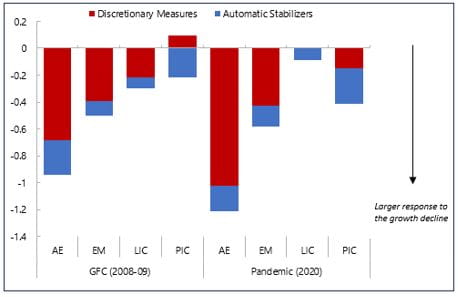
Policies became significantly more countercyclical after the global financial crisis (GFC). This has been the case especially among advanced economies (AEs)—for a 1 percentage point decline in real economic growth, the fiscal balance is estimated to deteriorate by almost 0.6 percent of GDP—reflecting both automatic stabilizers (for example, changes in income tax and unemployment benefits due to changes in economic activity) and discretionary measures (for example, cash transfers to households or subsidies to firms).  

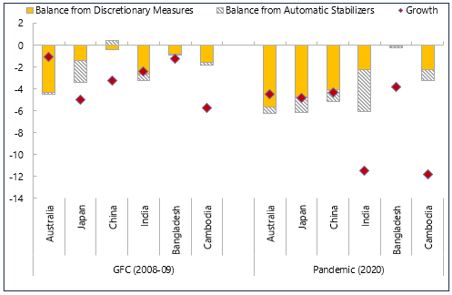
The degree of countercyclicality was especially large during the GFC and the pandemic (Figure 1). AEs and emerging markets relied mainly on discretionary measures as automatic stabilizers were too limited. For example, Australia and Japan adopted large discretionary policies in response to the pandemic, with overall balances deteriorating by more than 6 percent of GDP in 2020 relative to the previous three-years. Fiscal deficits also expanded significantly in China and India. Among low-income countries, fiscal responses tended to be more muted, but there were differences: fiscal balance in Bangladesh barely changed, while the deficit expanded in Cambodia.  

Figure 1. Fiscal Policy in Asia-Pacific the Global Financial Crisis and the Pandemic

1. Change in Fiscal Balance per country group (Percent of GDP, per 1 percentage point decline in GDP growth)2. Changes in Fiscal Balances and Economic Growth for selected countries (Percent of GDP; percentage points)
          graphic-1 
          graphic-2    

Source: Authors’ calculations.  
Note: In panel 1, red and blue bars denote the estimated changes in fiscal balance from discretionary measures and automatic stabilizers, in response to 1 percentage point decline in GDP growth, based on 5-year windows that include the GFC (2008 and 2009) or the pandemic (2020). In panel 2, orange and patterned bars denote the deviation in the balances from the previous three-year average, and red diamonds denote the deviation in growth from its previous three-year average. See Annex 1.  AE = advanced economies; EM = emerging markets; GFC = global financial crisis; LIC = low-income countries; PIC = Pacific Island countries. 

Fiscal frameworks under pressures

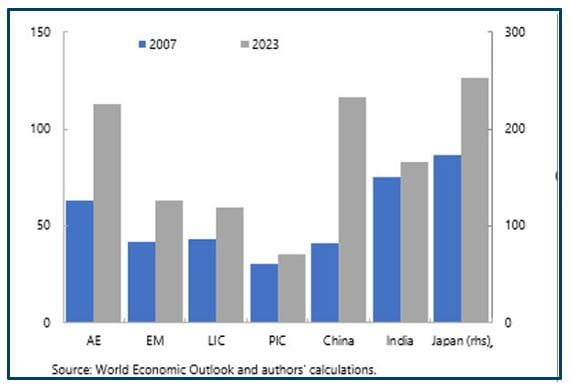
The responses to the crises, however, came at a cost, with public debt rising continuously since the GFC. Debt levels in Asia-Pacific are on average 50 percent of GDP higher relative to 2007 among AEs and 15-20 percent of GDP higher among others (Figure 2).  For example, the level of debt more than doubled in China to above 100 percent of GDP, and in Japan rose above 250 percent of GDP.

The large shocks, especially the pandemic, have also highlighted that fiscal frameworks have not been sufficiently robust. For example, 23 countries in the region that had fiscal rules tended to comply more with the rules, or have smaller deviations, than their peers in other regions before Covid hit–the median deviation from the debt ceiling in Asia-Pacific was just over 5 percent of GDP.

However, governments bypassed or modified their fiscal rules to address the pandemic. As debt levels had already been rising in the Asia-Pacific region, the effects of and policy responses to the pandemic led to large deviations from or suspensions of fiscal rules. Most governments breached the deficit rules in 2020-22, with the median deviation reaching 6.6 percent of GDP and larger than in other regions.     

The tools used to respond to crises, including social safety nets, were underdeveloped in some countries, requiring ad-hoc actions that were not always well targeted or timely. In some cases, extra-budgetary measures were larger than budget support during Covid. In addition, some countries did not have clear exit strategies, which, in some cases, led to procyclical expansionary policies after the shocks.

Figure 2. Public Debt Soared in Asia-Pacific since the Global Financial Crisis (Mean of respective group, percent of GDP)  
graph-3

Sources: IMF, World Economic Outlook database; and authors’ calculations.  

Note: AE = advanced economies; EM = emerging markets; LIC = low-income countries; PIC = Pacific island countries; rhs = right scale

Upgrading Fiscal Frameworks

Governments now face the challenge of managing high debt levels and growing spending pressures to achieve development goals and to address demographics and climate change. In addition, the weaker growth outlook and higher interest rates imply that the level of debt that governments can sustain is lower. 

Such challenges make it more pressing to strengthen medium-term fiscal frameworks. While many countries have some form of medium-term fiscal frameworks—encompassing a fiscal plan or strategy, medium-term projections, and targets or rules that guide annual budgets—they are not always well-developed or effective. Upgrading medium-term fiscal plans will help to identify what measures are needed today to achieve future goals. For countries with high or rising debt risks, it would help develop credible plans to gradually reduce debt, while avoiding disruptive fiscal adjustments. For low-income countries, it would help build support for a development strategy, including enhancing domestic revenues.

Improved fiscal frameworks should include better assessment of risks and necessary fiscal buffers, improved safety nets, and other crisis tools to allow for timely and targeted responses to adverse shocks. Expanding the coverage and improving the quality of government finances and debt statistics would also improve fiscal management.   

A risk-based fiscal rules approach could make rules more robust. It requires developing medium-term plans and fiscal rules that are more ambitious depending on the degree of risks, building enough fiscal buffers in good times, and well-designed escape clauses.

Governments also need to better integrate the effects of aging and climate change in fiscal frameworks. Population is already shrinking in China, Japan, and Korea, and population growth will turn negative in many developing economies over the next 15 years. The region also includes some of the most vulnerable countries to climate change. Improved medium-term fiscal frameworks can help reflect these effects and the tradeoffs from alternative reforms, including in the transition to a green economy.

Some of these reforms are difficult and will take time, but are critical for a more impactful and effective fiscal policy.  


Discover more from The European Sting - Critical News & Insights on European Politics, Economy, Foreign Affairs, Business & Technology - europeansting.com

Subscribe to get the latest posts sent to your email.

Interesting reads

Three seafarers killed in Hormuz strike as UN warns of widening fallout

This article is published in association with United Nations. Three Indian seafarers were killed in an attack on an oil tanker near the Strait of Hormuz on Wednesday, as renewed hostilities in one of the world’s most critical shipping corridors once again heightened concern over food security, fuel prices and broken global supply chains. The latest […]
© UNICEF/Royena Rasnat A group of Rohingya refugee children attend an activity centre in Cox's Bazar in Bangladesh.

Refugee numbers drop for first time in a decade, but millions remain trapped

This article is published in association with United Nations. Global forced displacement has decreased for the first time in a decade, the UN refugee agency (UNHCR) reported on Thursday, though the figure remains unacceptably high and tens of millions of people are still trapped in prolonged exile with little prospect of rebuilding their lives. UNHCR‘s flagship […]
This article is published in association with European Investment Bank.

Miles for Water: The Daily Health Burden of Climate Change on Women

This article was exclusively written for The European Sting by Ms. Jasminy Musa Belotti Dessiyeh, a 19-year-old medical student at FACISB (Faculdade de Ciências da Saúde de Barretos), Brazil. She is affiliated with the International Federation of Medical Students Associations (IFMSA), cordial partner of The Sting. The opinions expressed in this piece belong strictly to the writer and […]
© UNICEF A child is vaccinated against multiple diseases at a health centre in Cuba.

Children are dying as US sanctions push Cuba to the brink, warns UN human rights chief

This article is published in association with United Nations. Children are dying because doctors cannot access essential medicines, UN human rights chief Volker Türk said in a stark warning on Monday, calling for the immediate lifting of United States sanctions against the Caribbean nation that were causing “widespread harm”. “The fuel restrictions imposed since early 2026 and recent tightening of […]
© UNOCHA/Adedeji Ademigbuji Children displaced by the recent violence in Jonglei State, South Sudan, sit outside a church, home to thousands of displaced people.

World News in Brief: Millions displaced in South Sudan, global meat supply quadruples, Middle East crisis deepens global hunger

This article is published in association with United Nations. Months of fighting and insecurity have forced hundreds of thousands of people to flee their homes in South Sudan’s eastern Jonglei State, triggering “one of the most severe conflict-related displacement emergencies in recent years”, the UN refugee agency (UNHCR) said on Friday.  Tweet URL Fighting between the […]
© WFP/Marco Frattini Aid is distributed to displaced families in northern Lebanon.

Lebanon crisis: Needs soar as UN launches new funding appeal

This article is published in association with United Nations. The UN in Lebanon appealed for an additional $331.5 million on Friday to help 1.4 million people in crisis as already massive needs continue to grow, three months since deadly violence erupted between Hezbollah fighters and Israeli forces. “Humanitarian needs are soaring with each day of the […]
© UNICEF/Amer Almohibany Destroyed buildings in Harasta, Ghouta. A suburb of Damascus, Ghouta was the site of a deadly chemical weapons attack in August 2013.

Undeclared chemical weapons found in Syria, including type used in notorious Ghouta massacre

This article is published in association with United Nations. Chemical weapons inspectors have uncovered a significant cache of previously undeclared chemical weapons in Syria – including rockets of the same type used in the notorious 2013 Ghouta attack – in what the UN’s top disarmament official called a “momentous discovery” for international security. Izumi Nakamitsu briefed […]
© UNICEF Vanessa Frazier, Special Representative on Children and Armed Conflict, during a visit to frontline areas in Ukraine.

Growing up with sirens: UN child rights envoy on the toll of the Ukraine-Russia war

This article is published in association with United Nations. Children in Ukraine have been profoundly impacted by years of war, sheltering in underground schools – or forced to study online – and living with the psychological strain of constant air raid sirens that could spell death for them and their families. But children on both sides […]
OCHA/Charlotte Cans The El Niño-induced drought in Ziway Dugda, Oromia region of Ethiopia, is affecting every family and they don't have enough food at home to feed themselves. (file photo).

El Niño confirmed, set to fuel more extreme weather, says WMO

This article is published in association with United Nations. The UN urged all countries on Tuesday to bolster early warning systems after confirming the onset of El Niño, warning that the Pacific Ocean-warming phenomenon will bring above-average temperatures “nearly everywhere” and fuel more extreme weather. According to the World Meteorological Organization (WMO), there is an 80 […]
© UNICEF The aftermath of a Russian strike on a residential area in Kyiv, Ukraine’s capital.

UN deplores another wave of Russian attacks across Ukraine

This article is published in association with United Nations. Overnight attacks in three key cities in Ukraine have left several civilians dead, scores more injured, and homes, hospitals and shops destroyed or damaged, the UN Humanitarian Coordinator in the country said on Tuesday.  Matthias Schmale condemned the large-scale Russian assault on the capital Kyiv, as well as Dnipro and Kharkiv, […]
© WHO/Joël Lumbala A shipment of essential medical supplies for the Ebola response arrives at Bunia airport in Ituri province, DR Congo.

DR Congo Ebola outbreak: Nurses discharged after full recovery

This article is published in association with United Nations. Four nurses who fell ill with Ebola in the eastern Democratic Republic of the Congo (DRC) have been discharged from hospital after recovering from the often-fatal illness that sparked an international health alert.  “More recoveries are expected, especially when people are diagnosed early and able to access care, and […]
This article is published in association with United Nations.

Under fire, Kharkiv is already building for a peaceful tomorrow

This article is published in association with United Nations. Every day in Kharkiv begins with uncertainty: air raid sirens interrupt sleep; missiles strike residential neighbourhoods, industrial sites, and roads. Anxious citizens rush into metro stations during bombardments and children study underground. Yet amid the destruction, Ukraine’s second-largest city is doing something that may seem almost impossible […]
© UNOCHA A heavily damaged apartment building in Sloviansk, eastern Ukraine.

UN warns Ukraine war risks spiralling ‘out of control’

This article is published in association with United Nations. The United Nations on Thursday warned of a dangerous escalation in the war in Ukraine after a wave of large-scale Russian strikes and threats of further attacks, with Secretary-General António Guterres saying “the death spiral must stop.” Addressing the Security Council in New York, Mr. Guterres said […]
© WHO A frontline health worker in PPE (personal protective equipment) takes part in the Ebola response in eastern Democratic Republic of the Congo.

Ebola outbreak in DR Congo collides with conflict and hunger, WHO warns

This article is published in association with United Nations. The UN World Health Organization (WHO) on Wednesday warned that eastern Democratic Republic of the Congo faces a “catastrophic collision of disease and conflict” as a fast-spreading Ebola outbreak outpaces containment efforts in a region already battered by armed violence, mass displacement and acute hunger. WHO Director-General […]
© WFP/Michael Castofas WFP staff and responders handle boxes of supplies at a logistics site in DR Congo during the Ebola outbreak.

International airlines urged to stick to safety measures in wake of Ebola outbreak

This article is published in association with United Nations. As a deadly Ebola strain continues to spread in the Democratic Republic of the Congo (DRC), with cases confirmed in neighbouring Uganda, the UN aviation agency is urging governments and flight operators to closely follow guidelines put in place following the COVID-19 pandemic. The outbreak of the […]
© WHO Supplies to bolster the response against the Ebola outbreak in Ituri province arrive in the town of Bunia.

Ebola epidemic spreading rapidly and outpacing containment efforts

This article is published in association with United Nations. There are more than 900 suspected cases of the Bundibugyo strain of Ebola in the Democratic Republic of the Congo, and 220 suspected deaths, the head of the World Health Organization (WHO), Tedros Ghebreyesus, said on Monday. The latest outbreak of the deadly disease, which WHO has declared […]
This article is published in association with United Nations.

WHO chief calls for urgent Ebola action and pandemic preparedness

This article is published in association with United Nations. The recent Ebola and hantavirus outbreaks demonstrate that the world is still vulnerable to rapidly spreading infectious diseases, Tedros Ghebreyesus, the head of the World Health Organization (WHO), warned on Saturday at the close of the 79th World Health Assembly in Geneva. His call came as Ugandan […]
This article is published in association with United Nations.

UN agencies step up Ebola response in eastern DR Congo

This article is published in association with United Nations. United Nations agencies have moved swiftly to support efforts to contain the latest Ebola outbreak in eastern Democratic Republic of the Congo (DRC), delivering emergency medical supplies, protective equipment and logistics support. As health authorities in both the DRC and Uganda respond to the deadly resurgence, the […]
© UNICEF/Josue Mulala Emergency aid is prepared for delivery to Kasaï province in response to the recently declared Ebola virus disease outbreak in DR Congo.

Ebola risk is high inside DR Congo but it’s no pandemic emergency: WHO

This article is published in association with United Nations. The deadly Ebola outbreak in Democratic Republic of the Congo (DRC) and Uganda does not represent a global pandemic emergency, although the risk is high at a regional and national level, the UN health agency chief said on Wednesday. In an update on the fast-developing situation in […]

Why don't you drop your comment here?

Go back up

Discover more from The European Sting - Critical News & Insights on European Politics, Economy, Foreign Affairs, Business & Technology - europeansting.com

Subscribe now to keep reading and get access to the full archive.

Continue reading

Discover more from The European Sting - Critical News & Insights on European Politics, Economy, Foreign Affairs, Business & Technology - europeansting.com

Subscribe now to keep reading and get access to the full archive.

Continue reading

The European Sting – Critical News & Insights on European Politics, Economy, Foreign Affairs, Business & Technology – europeansting.com