5 ways Indigenous people are protecting the planet

(Credit: Unsplash)

This article is brought to you thanks to the collaboration of The European Sting with the World Economic Forum.

Author: Douglas Broom, Senior Writer, Forum Agenda


  • Indigenous people make up just 5% of the global population.Yet they have a critical role in protecting the planet, a World Economic Forum report says.To mark International Day of the World’s Indigenous Peoples, here’s what we can learn from them about living more sustainably and fighting the climate crisis.

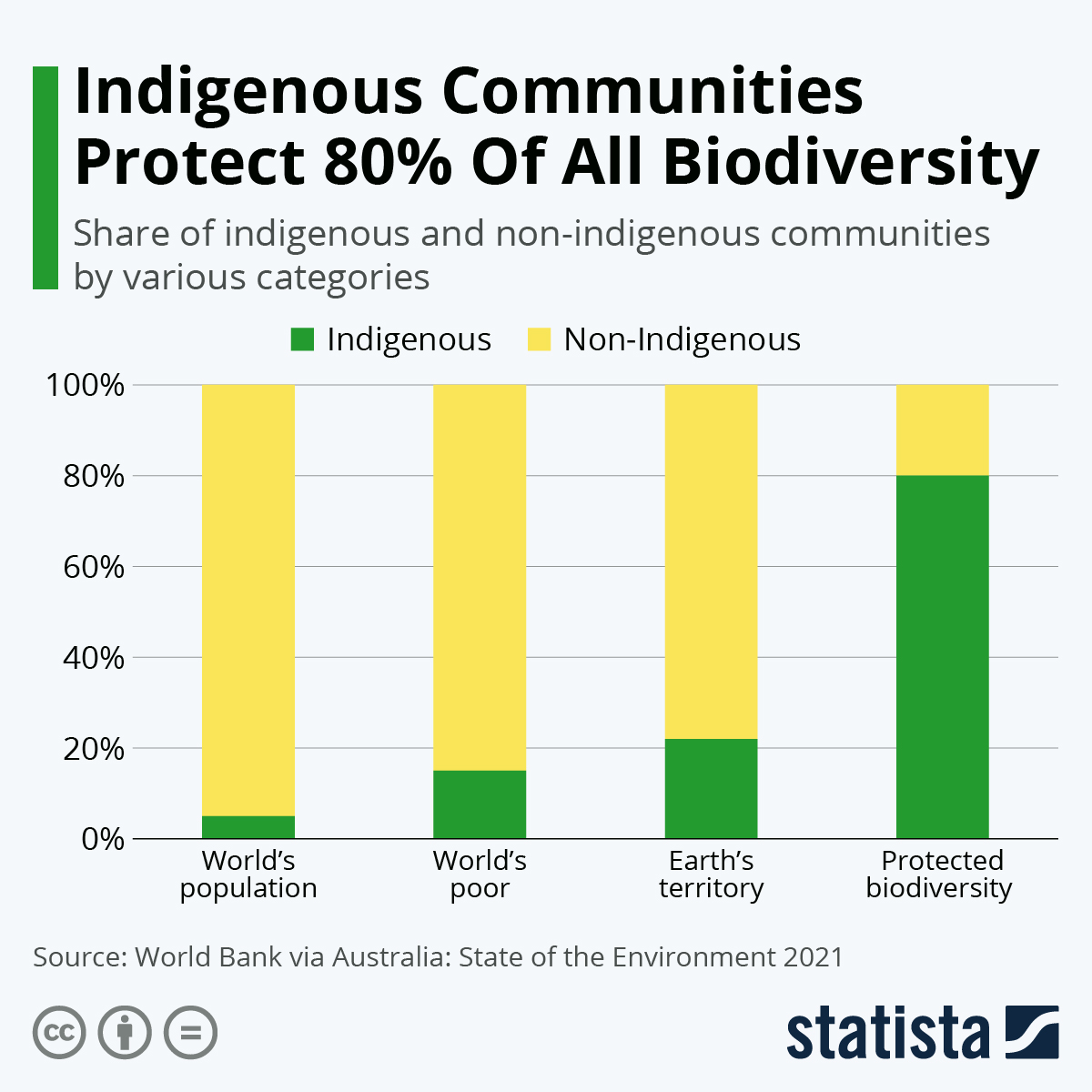
One-third of the Earth’s surface is in the care of Indigenous peoples and local communities – and it’s in better environmental shape than most of the rest of the world. Maybe we could learn something from Indigenous people about how to care for our world?August 9 is the United Nations’ International Day of the World’s Indigenous Peoples, a chance to reflect on the lives and contributions of the estimated 476 million Indigenous people who live across 90 countries.As the inheritors of unique ways of living, Indigenous peoples have long suffered discrimination and worse, according to the UN. But despite a history of oppression, their ability to live in harmony with nature is increasingly understood and appreciated.Although they make up less than 5% of the global population, Indigenous people protect 80% of Earth’s remaining biodiversity. Their critical role is highlighted in the World Economic Forum’s 2023 report Embedding Indigenous Knowledge in the Conservation and Restoration of Landscapes.Here are some of the ways they are protecting the planet.

1. Safeguarding knowledge

Indigenous people have unique insights into how to conserve and protect the environment, built up, as the Forum’s report pointed out, over literally thousands of years and deeply embedded in their cultures.The very survival of Indigenous communities in often challenging environments is proof of the value of their knowledge when it comes to helping the rest of the globe cope with the climate crisis, experts say.The United Nations’ International Fund for Agricultural Development (IFAD) put it like this: “The inherent dynamism of Indigenous peoples’ knowledge systems lies at the heart of their ability to adjust and modify their actions in response to environmental change”.

2. Food for all

Indigenous people are experts at small-scale community food production and the IFAD says the rest of the world could learn a lot from their approach in a world where globalized food systems have come under threat from war and COVID-19.The success of Indigenous people in producing healthy food while protecting their natural environments benefits the whole world, says the Forum’s report which adds: “maintaining biodiversity is critical to ensuring a sustainable food supply, as well as providing protection from pollution, flooding and climate breakdown”.Yet small-scale farmers are particularly vulnerable to the effects of the climate crisis, which is why IFAD has invested in the Slow Food initiative which helps smallholders to increase output and to market their produce to a wider audience.

Discover

How does the World Economic Forum encourage biological diversity?

In the last 100 years, more than 90 percent of crop varieties have disappeared from farmers’ fields, and all of the world’s 17 main fishing grounds are now being fished at or above their sustainable limits.These trends have reduced diversity in our diets, which is directly linked to diseases or health risk factors, such as diabetes, obesity and malnutrition.One initiative which is bringing a renewed focus on biological diversity is the Tropical Forest Alliance.

This global public-private partnership is working on removing deforestation from four global commodity supply chains – palm oil, beef, soy, and pulp and paper.The Alliance includes businesses, governments, civil society, indigenous people and communities, and international organizations. Enquire to become a member or partner of the Forum and help stop deforestation linked to supply chains.
3. Enhancing biodiversity
Statistic illustrating the share of indigenous and non-indigenous communities by various categories.
Indigenous people protect 80% of Earth’s remaining biodiversity. Image: Statista

Nearly half of the world’s endangered mammals live on land owned and protected by Indigenous people. In many countries, the richness of animal and plant life found on indigenous people’s land is comparable to protected nature reserves, the Forum report says.Indigenous people also play a key role in protecting the Earth’s forests. Research for the Forum’s 2022 Forests for Climate whitepaper found that rates of deforestation in areas inhabited by Indigenous people were three to four times lower than neighbouring lands.“Globally, Indigenous people manage nearly 300 billion tonnes of carbon stored above and below ground, equal to more than 30 years’ worth of global emissions,” the whitepaper noted, adding that the inclusion of indigenous peoples was becoming a condition for certification and funding of carbon offsetting schemes.

4. Custodians of the land

It’s estimated that half of the world’s land is in the custodianship of Indigenous peoples and other local communities, according to the World Resources Institute (WRI). And it’s not just the world’s Indigenous people who benefit – 2.5 billion people depend on these lands for their livelihoods.Speaking at Davos 2023, Fawn Sharp, President of the National Congress of American Indians, said that “we have no margin of error” when it comes to tackling the climate crisis and that “the most significant thing that people can learn from Native Americans is our spiritual connection to our lands, our spiritual connection to our creator”.

View of a boat in a river.
Indigenous people are custodians of their landscapes. Image: Unsplash/Kiyoshi

Indigenous people are on the frontline against illegal exploitation of the lands they occupy, even where government protections are in place. WRI says that in the Amazon rainforest patrols by Indigenous people have successfully stopped illegal logging.In Suriname, Indigenous people took the initiative to declare 7.2 million hectares of rainforest as the Indigenous Southern Suriname Conservation Corridor, acting as rangers to ensure its protection. The government subsequently gave the Corridor official status by recognizing their declaration.

5. Taking climate action

Just by pursuing their traditional methods of cultivation, Indigenous people are acting to reduce carbon emissions which cause climate change. The Forum’s Embedding Indigenous Knowledge report said the re-introduction of traditional controlled forest-burning by indigenous peoples of Northern Australia had halved the volume of carbon-emitting wildfires.In February 2023, Indigenous people from all over the world met at the Indigenous Peoples’ Forum to discuss ways to spread their knowledge about how to promote sustainable ways of living and farming.Warning that Indigenous people are particularly affected by the impacts of climate change, they called on governments to ensure that they include Indigenous people in discussions and decision-making about measures to tackle the climate emergency.“I think the question that we need to be asking ourselves is, how can we make sure that it’s not a privilege, but ensure that it’s a right that we have to be in nature?” said Helena Gualinga, Co-Founder, Indigenous Youth Collective of Amazon Defenders, Ecuador, at Davos 2023. “And how can we make sure that we can restore these places that have been degraded

elsewhere in the world so that we all can have access to nature?”

Discover more from The European Sting - Critical News & Insights on European Politics, Economy, Foreign Affairs, Business & Technology - europeansting.com

Subscribe to get the latest posts sent to your email.

Interesting reads

© IMO/Cihancan Tunay A ship makes its way across an ocean.

Chokepoints and conflict: How the Hormuz crisis is exposing global shipping vulnerabilities

This article is published in association with United Nations. The blockading of ships in the Strait of Hormuz as a result of the conflict between the United States and Iran has demonstrated how ships and seafarers have become “leverage in geopolitical disputes,” according to the head of the UN’s International Maritime Organization (IMO). Since conflict began […]
Middle East war: After oil and gas, concerns grow over minerals crunch

Middle East war: After oil and gas, concerns grow over minerals crunch

This article is published in association with United Nations. The shipping crisis in the Strait of Hormuz caused by war in the Middle East has exposed a new threat: a looming shortage of strategic minerals that drive economies all over the world – and a race by countries to obtain them. Until war erupted on 28 […]
This article is published in association with United Nations.

Ceasefire extension offers diplomatic opening, but tensions persist in Strait of Hormuz

This article is published in association with United Nations. The United States’ decision to extend a fragile ceasefire with Iran has kept a narrow window open for diplomacy, but fresh security incidents in the Strait of Hormuz on Wednesday underscore the volatility of the situation and the risks to global shipping and regional stability. The UN […]
UN News Moreira da Silva (right), Executive Director of UNOPS on a visit to the Gaza Strip.

Strait of Hormuz: With hunger looming, life-saving fertiliser shipments cannot wait, head of UN task force says

This article is published in association with United Nations. As the Persian Gulf crisis continues, time is ticking for farmers who rely on fertilizer shipped via the Strait of Hormuz – and millions worldwide who depend on their crops, particularly in vulnerable countries such as war-torn Sudan.  In normal times, one third of global fertiliser trade […]
UN News A popular market in Khan Younis, southern Gaza Strip.

Economic collapse pushes highly educated Gazans into the ‘survival economy’

This article is published in association with United Nations. Young Palestinians in Gaza with university-level educations are setting aside dreams of putting their hard-won skills into practice and doing whatever they can to survive.  Abdullah al-Khawaja, an electrical engineering graduate displaced from Rafah to Khan Younis, now stands behind a small spice stall, having lost the […]
MONUSCO/Didier Vignon Dossou-Gbakon MONUSCO peacekeepers protect civilians in Ituri, eastern DRC.

World News in Brief: AI diagnostics, humanitarian deal for DR Congo, rights abuse allegations in Belarus, Ukraine children bear heaviest burden

This article is published in association with United Nations. New data shows that nearly three in four countries in Europe now use Artificial Intelligence in their health services to make a diagnosis. According to the UN World Health Organization (WHO) joint report with the European Union, 74% of countries in the bloc use AI tools in medical […]
© WFP The conflict in the Middle East is impacting the cost of food in many parts of the world.

Time running out on development goals as finance dries up, UN warns

This article is published in association with United Nations. Rising conflicts, the climate crisis and shrinking development finance are putting growing pressure on the poorest and most vulnerable countries – pushing development goals further off track. The warning comes in the Financing for Sustainable Development Report 2026 (FSDR), a new UN report launched on Monday, which finds […]
Ukraine’s women at breaking point after four years of war as attacks on energy, healthcare continue – UN humanitarians

World News in Brief: Myanmar amnesty, rising needs in Afghanistan, another power loss at Ukraine nuclear plant

This article is published in association with United Nations. Authorities in Myanmar released the country’s ousted president from prison on Friday, along with some 4,000 other people, as part of an amnesty to mark the traditional New Year festival. President Win Myint had been in jail since February 2021 when the military overthrew Myanmar’s democratically elected […]
UN Photo/Eskinder Debebe Siobhán Mullally, Special Rapporteur on Trafficking in Persons, especially women and children, one of the UN independent human rights experts calling for more accountability for the alleged trafficking victims in the Epstein files.

The Epstein files: Rights experts demand accountability, call for probe into trafficking allegations

This article is published in association with United Nations. UN independent human rights experts called on Thursday for justice and accountability for young women and girls who were trafficked systematically as part of allegations contained in the so-called Epstein files. The Human Rights Council-appointed experts also issued a general warning over the “continuing violence of patriarchal power systems” revealed […]
© World Bank A ship offloads its cargo at the port in Nuku'alofa, Tonga.

Middle East conflict chokes end of supply chain as lights go out in the Pacific

This article is published in association with United Nations. For Pacific Island countries, the Middle East crisis is not a distant geopolitical event. It is already showing up in higher fuel prices, electricity uncertainty and fears that communities sitting at the far end of global supply chains could be pushed into deeper economic insecurity. “We are […]
© UNICEF/Fouad Choufany The Basta neighbourhood in Beirut, Lebanon, lies in ruins.

‘Time for diplomacy over escalation’ in Middle East war: Guterres

This article is published in association with United Nations. As the war in the Middle East continues, the United Nations Secretary-General issued a passionate call for “serious negotiations” between the US and Iran to resume, warning that respect for international law “is being trampled” underfoot.  Addressing journalists at UN Headquarters in New York outside the Security […]
© IFAD/GMB Akash Prolonged disruptions to fuel and natural gas supplies could affect the global availability of fertilizers and impact crop yields. (file photo)

‘Clock is ticking’: Hormuz disruption raises fears of global food crisis

This article is published in association with United Nations. The clock is ticking for global food systems as disruptions in the Strait of Hormuz threaten to choke off the flow of fuel and crucial fertilizers needed for the next planting season – also raising the risk of higher food prices and a new wave of inflation.  […]
This article is published in association with United Nations.

Lebanon airstrike casualties ‘still under the rubble’ as ambulances, hospitals face new threats

This article is published in association with United Nations. With Lebanon still reeling from Israel’s devastating airstrikes on 8 April, UN humanitarians reported new fears of attacks on ambulances and looming food shortages in the south of the country on Friday. Speaking from Beirut, where he witnessed Wednesday’s attacks first-hand, the World Health Organization (WHO)’s representative […]
This article is published in association with United Nations.

Lebanon: Health system overwhelmed following a ‘horrific’ day of Israeli strikes

This article is published in association with United Nations. The scale and speed of destruction from the wave of airstrikes in Lebanon which began just hours after the US-Iran ceasefire announcement, has left the country’s already strained health system struggling to cope, according to the World Health Organization (WHO). WHO Representative in Lebanon Dr. Abdinasir Abubakar […]
© NASA/Jeff Schmaltz A satellite image shows the Strait of Hormuz. (far right)

Iran ceasefire raises hopes for reopening key Strait of Hormuz

This article is published in association with United Nations. The announcement of a shaky two-week ceasefire between the US and Iran, will it is hoped, lead to the opening of the strategically important Strait of Hormuz, a vital waterway through which one fifth of the world’s oil and gas passes. The strait has become a global […]
Fokah Wembe Darrell Dupray is a 4th-year medical student at Université des Montagnes, Bangangté Cameroon and a student leader within the Cameroon Medical Students’ Association (CAMSA).

Global Health Priorities for the Year Ahead: Why the Next Generation Must Lead

This article was exclusively written for The European Sting by Mr. Sharif Mohammed Sadat, a medical student from Bangladesh and serves as the Regional Director for Asia-Pacific of the International Federation of Medical Students’ Associations (IFMSA). He is affiliated with the International Federation of Medical Students Associations (IFMSA), cordial partner of The Sting. The opinions expressed in this […]
© IOM Families returning to Khartoum face the mounting task of rebuilding their lives and livelihoods amid damaged homes and limited access to basic services (file).

World News in Brief: ‘Skyrocketing’ needs outpace Sudan funding, Ukraine strikes update, global water security

This article is published in association with United Nations. The UN is significantly scaling up its presence in the Sudanese capital, Khartoum, to expand life-saving operations as the conflict between rival militaries approaches its third year. UN Resident and Humanitarian Coordinator Denise Brown has returned to the city with a core team, marking a renewed commitment […]
© UNHCR Smoke and debris from a building in the Bashura neighbourhood of Beirut, Lebanon, after an airstrike.

MIDDLE EAST LIVE 6 April: Strikes persist across region as humanitarian needs rise

This article is published in association with United Nations. Strikes and counter-strikes continue across the Middle East, with dozens of casualties reported over the weekend in Lebanon following Israeli strikes targeting the south and the capital, Beirut. Meanwhile, humanitarian needs are rising, critical infrastructure remains under strain, and the wider economic and global impacts of the […]
This article is published in association with United Nations.

UN nuclear agency chief ‘deeply concerned’ by reports of latest attack on Iran power plant

This article is published in association with United Nations. Reports of yet another projectile strike near the Bushehr nuclear power plant prompted Rafael Grossi, head of the International Atomic Energy Agency (IAEA), to register his deep concern on Saturday. The IAEA was informed of the strike – the fourth such incident in recent weeks – by […]

Why don't you drop your comment here?

Go back up

Discover more from The European Sting - Critical News & Insights on European Politics, Economy, Foreign Affairs, Business & Technology - europeansting.com

Subscribe now to keep reading and get access to the full archive.

Continue reading

Discover more from The European Sting - Critical News & Insights on European Politics, Economy, Foreign Affairs, Business & Technology - europeansting.com

Subscribe now to keep reading and get access to the full archive.

Continue reading

The European Sting – Critical News & Insights on European Politics, Economy, Foreign Affairs, Business & Technology – europeansting.com

