Poverty data never tells the whole story

poverty

(Unsplash, 2019)

This article is brought to you thanks to the collaboration of The European Sting with the World Economic Forum. Author: Clayton Christensen, Professor of Business Administration, Harvard Business School & Efosa Ojomo, Senior Research Fellow, Global Prosperity, Clayton Christensen Institute for Disruptive Innovation & Karen Dillon, Senior Researcher, Global Prosperity, Clayton Christensen Institute for Disruptive Innovation
As global leaders gather at the World Economic Forum to discuss some of the world’s most pressing issues, including inequality and poverty, many will share data to illustrate a phenomenon. However, countries that focus on creating prosperity and not just merely eradicating poverty react differently to data on poverty.

Alleviating poverty is not the same as creating prosperity

Hard as it may be to believe, decades ago Singapore was very impoverished, and one of the main initiatives of the government was to educate its citizens. But when Dr. Goh Keng Swee, one of Singapore’s ministers, would see hundreds of children streaming out of school at the end of the day, instead of being happy, he was heartbroken. He and the Singaporean government understood that simply attending school wasn’t enough. What would the students do after they graduated? How would the economy create and sustain jobs for all these newly educated children? Those were the questions that Dr. Keng Swee was asking.
Focusing on creating prosperity – in contrast to focusing on alleviating poverty – compelled Dr. Keng Swee and the government to ask entirely different questions, pursue different activities and emphasize different metrics. Instead of mostly focusing on the data, they focused on the deeper underlying phenomena. And so, instead of primarily building schools, Singapore prioritized investments and innovation and attracted companies that created jobs. This decision increased the need for education.
As a result, Singapore has become one of the richest nations in the world with a GDP per capita of approximately $57,714. And today, not only do approximately 99% of people attend secondary school, but more than half go on to get a post-secondary school diploma. What would have happened if – as many nations do today – Singapore focused primarily on the data of how many children were educated? It might not be as successful today. The phenomena – the realities on the ground – drive the data.
With trillions of dollars spent in official development assistance over the past several decades, and hundreds of billions spent annually, we believe that if more nations focused on realities underlying the data, we would not only eradicate poverty in the next couple of decades, but we set nations on a path to creating long-term economic prosperity.

What the data hides

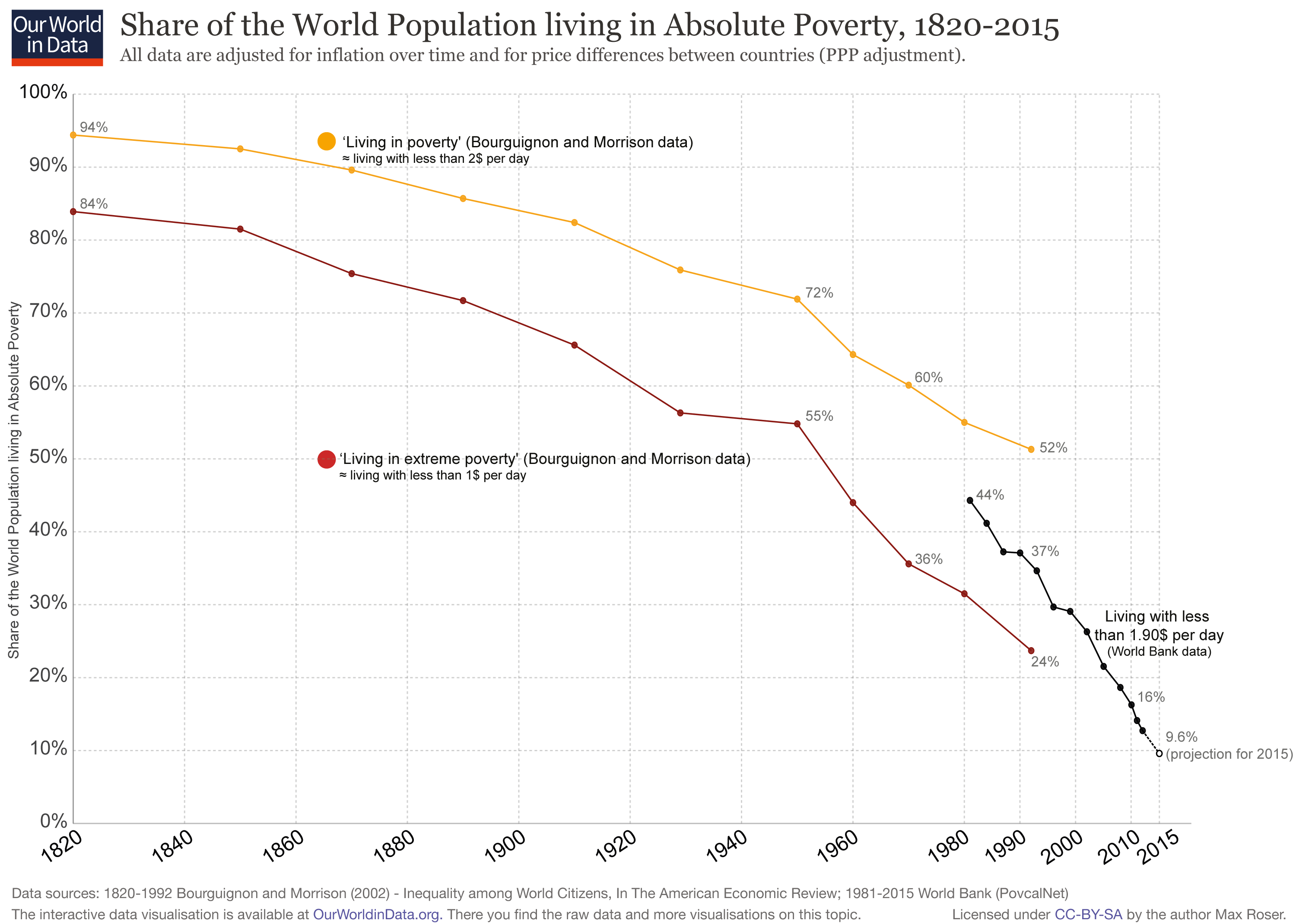
Over the past three decades, more than 1 billion people have lifted themselves out of extreme poverty. The rate of global poverty is down from 37% in 1990 to approximately 10% today. But a vast majority of the people who have escaped poverty are from China (approximately 800 million people) and to a lesser extent, India (approximately 200 million).
Poverty in many countries in sub-Saharan Africa is actually on the rise, with no signs of slowing down. In addition, nearly half the world’s population – 3.4 billion people – live on less than $5.50 a day and struggle to meet their basic needs. The problem is that this data can be deceptive. We are awash in data, and we do need this information. But data, metrics and statistics are simply representations of particular phenomena and are not the phenomena themselves.
Consider another example. The data shows that primary and secondary school enrolment rates are now almost on par with rates in high-income countries. That’s a good thing. However, what the data doesn’t illustrate as clearly is that the quality of education couldn’t be more different. In low- and middle-income countries, for instance, more than half the students in school (over 617 million) are not achieving minimum proficiency levels, according to a United Nations study. In sub-Saharan Africa, the number is about 90%. In addition, international assessments of literacy and numeracy show that the average student in a low-income country performs worse than 95% of the students in high-income countries. What this ultimately means is that students are attending school, but are not learning. This is important because programs, laws and investments can cause the statistics to nominally improve, even when reality is going in a different direction.

The importance of understanding the phenomena

In most corporations, a very common measure of success for a firm is the return on net assets (RONA), which is the ratio of income divided by its assets. In essence, RONA tells us how well a company utilizes its assets. If the firm’s RONA goes up, one interpretation might be that customers are willing to pay higher prices for the company’s products.
But RONA can hide the real story. Managers, for instance, can manipulate the ratio by outsourcing as many activities as possible, thereby reducing the assets on their balance sheets. This causes RONA to go up as well. When a company outsources, say, the manufacturing, testing or distribution activity, the company is able to remove assets from its balance sheet, thereby increasing its RONA. There’s nothing inherently wrong with this, but it matters because it could be masking something far more worrying. In essence, what might seem to be, on paper, the story of a company that is thriving, could be more complex. A company might be able to operate with these inflated RONA numbers for years, but eventually the chickens come home to roost. By then, it is usually too late. Fewer corporations illustrate this better than Dell Computer.
Dell Computer hit its stride in the 1990s and quickly became one of the most successful and profitable computer companies in the world. But over time, in an attempt to continually improve its efficiency metrics and financial ratios such as RONA, the company outsourced many of its operations to a Taiwanese company, Asus. Profitability skyrocketed, and Dell analysts rewarded the company accordingly. The data looked good, but the phenomena behind the data – the innovative prowess of the company – didn’t. In 2005, after Dell had outsourced enough activities to Asus, effectively putting the company into business, Asus announced the creation of its own brand of computers. And the rest, as they say, became history. All along, the numbers had looked good to Dell. But what the numbers had not shown was the impact these decisions would have on Dell’s future.
In a similar way, the metrics of poverty might improve, but that doesn’t mean that the phenomena of poverty are getting better. It might even be getting worse. But it need not be this way. Countries can reliably and sustainably overcome poverty and, indeed many have; however, they did not do it mainly by trying to eradicate poverty. They did it by focusing on creating prosperity. On the surface, the difference between the two strategies may seem like mere semantics, but that couldn’t be farther from the truth.

Discover more from The European Sting - Critical News & Insights on European Politics, Economy, Foreign Affairs, Business & Technology - europeansting.com

Subscribe to get the latest posts sent to your email.

Interesting reads

© Unsplash/Michu Đăng Quang The emissions from electricity or gasoline that power air conditioners contribute to global warming. "It's time to come clean" and do more to promote renewable energy, the UN Secretary-General told the London Climate Action Week.

Climate crisis: UN chief lays out solutions blueprint for clean energy transition

This article is published in association with United Nations. As a deadly heatwave continued to grip Europe on Tuesday, UN Secretary-General António Guterres issued an impassioned appeal for more ambitious global action on climate change caused by fossil fuels, to prevent irreversible damage. In a major keynote speech at London Climate Action Week, the UN chief […]

Libya’s political process regains momentum, but window for action is narrowing, UN envoy warns

This article is published in association with United Nations. Libya has been mired in political dysfunction since the collapse of Muammar Gaddafi’s regime in 2011, which shattered State institutions and triggered recurring struggles over legitimacy and power.  The country’s current stalemate pits the UN-recognised Government of National Unity in the capital Tripoli against eastern-based authorities backed […]
© UNICEF Chad hosts refugees from conflicts in neighbouring Sudan, the Central African Republic and Cameroon.

World Refugee Day: UN calls for renewed commitment and solidarity

This article is published in association with United Nations. The UN High Commissioner for Refugees has called on the international community to strengthen support for the nearly 42 million people worldwide who have fled their home countries to escape conflict, violence or persecution. Barham Salih highlighted the contributions refugees make to their host communities as workers, students, neighbours, […]
© WFP/Htet Oo Linn Families in Myanmar have been hit hard by rising prices, with the most vulnerable struggling to meet their daily needs.

US makes $1 billion contribution to UN child rights and food agencies

This article is published in association with United Nations. Two United Nations agencies have together welcomed more than $1 billion in assistance from the United States to support their operations targeting millions of children and hungry families in more than 40 countries. This week the US State Department announced a more than $800 million contribution to the […]
© UNICEF/Oleksii Filippov A bouquet of flowers and soft toys placed near the site of a missile strike, left in memory of the children killed in the early morning attack in Kyiv, Ukraine, on 24 April 2025.

‘Darkest chapter’: Record child violations in 2025, with national forces leading the way

This article is published in association with United Nations. For the first time, soldiers and Government forces were responsible for more grave violations against children in armed conflict than non-State armed groups – and 2025 set a grim new record for the total number of child victims.  The findings come in the annual UN report on Children and Armed […]
© UNICEF/Sukhum Preechapanich Children in Thailand are enduring extremely hot temperatures and drought. (file)

Triple climate threats affect nearly half the world’s children

This article is published in association with United Nations. Drought, extreme heat and heatwaves are the most prevalent trio of hazards endangering millions of children globally, warned a newly released climate report by the UN Children’s Fund (UNICEF). About 1.1 billion children now face at least three overlapping climate hazards, threatening their health, education and survival, […]
© UNOCHA Kyiv Pechersk Lavra is a UNESCO World Heritage Site and one of Ukraine's most significant religious and cultural landmarks.

Ukraine: Latest Russian attack kills civilians, damages cultural landmark

This article is published in association with United Nations. eral civilians were killed and dozens more were injured in the latest wave of overnight attacks in Ukraine that targeted the capital Kyiv, the city of Kharkiv and the country’s history and cultural heritage, the United Nations said on Monday. The Russian strikes damaged homes, schools and […]
© NASA/GSFC/Jacques Descloitres The Strait of Hormuz is a narrow but vital shipping route linking the Persian Gulf to the Gulf of Oman and the wider Arabian Sea. It lies between Iran to the north and Oman and UAE to the south.

Guterres welcomes US-Iran peace deal as ‘critical step’ toward ending conflict

This article is published in association with United Nations. UN Secretary General António Guterres welcomed on Sunday a new peace deal between the United States and Iran, calling it a “critical step” toward ending the conflict. According to a statement issued by his Spokesman, the agreement provides for an immediate and permanent ceasefire, the reopening of […]

Three seafarers killed in Hormuz strike as UN warns of widening fallout

This article is published in association with United Nations. Three Indian seafarers were killed in an attack on an oil tanker near the Strait of Hormuz on Wednesday, as renewed hostilities in one of the world’s most critical shipping corridors once again heightened concern over food security, fuel prices and broken global supply chains. The latest […]
© UNICEF/Royena Rasnat A group of Rohingya refugee children attend an activity centre in Cox's Bazar in Bangladesh.

Refugee numbers drop for first time in a decade, but millions remain trapped

This article is published in association with United Nations. Global forced displacement has decreased for the first time in a decade, the UN refugee agency (UNHCR) reported on Thursday, though the figure remains unacceptably high and tens of millions of people are still trapped in prolonged exile with little prospect of rebuilding their lives. UNHCR‘s flagship […]
This article is published in association with European Investment Bank.

Miles for Water: The Daily Health Burden of Climate Change on Women

This article was exclusively written for The European Sting by Ms. Jasminy Musa Belotti Dessiyeh, a 19-year-old medical student at FACISB (Faculdade de Ciências da Saúde de Barretos), Brazil. She is affiliated with the International Federation of Medical Students Associations (IFMSA), cordial partner of The Sting. The opinions expressed in this piece belong strictly to the writer and […]

© UNICEF A child is vaccinated against multiple diseases at a health centre in Cuba.

Children are dying as US sanctions push Cuba to the brink, warns UN human rights chief

This article is published in association with United Nations. Children are dying because doctors cannot access essential medicines, UN human rights chief Volker Türk said in a stark warning on Monday, calling for the immediate lifting of United States sanctions against the Caribbean nation that were causing “widespread harm”. “The fuel restrictions imposed since early 2026 and recent tightening of […]
© UNOCHA/Adedeji Ademigbuji Children displaced by the recent violence in Jonglei State, South Sudan, sit outside a church, home to thousands of displaced people.

World News in Brief: Millions displaced in South Sudan, global meat supply quadruples, Middle East crisis deepens global hunger

This article is published in association with United Nations. Months of fighting and insecurity have forced hundreds of thousands of people to flee their homes in South Sudan’s eastern Jonglei State, triggering “one of the most severe conflict-related displacement emergencies in recent years”, the UN refugee agency (UNHCR) said on Friday.  Tweet URL Fighting between the […]
© WFP/Marco Frattini Aid is distributed to displaced families in northern Lebanon.

Lebanon crisis: Needs soar as UN launches new funding appeal

This article is published in association with United Nations. The UN in Lebanon appealed for an additional $331.5 million on Friday to help 1.4 million people in crisis as already massive needs continue to grow, three months since deadly violence erupted between Hezbollah fighters and Israeli forces. “Humanitarian needs are soaring with each day of the […]
© UNICEF/Amer Almohibany Destroyed buildings in Harasta, Ghouta. A suburb of Damascus, Ghouta was the site of a deadly chemical weapons attack in August 2013.

Undeclared chemical weapons found in Syria, including type used in notorious Ghouta massacre

This article is published in association with United Nations. Chemical weapons inspectors have uncovered a significant cache of previously undeclared chemical weapons in Syria – including rockets of the same type used in the notorious 2013 Ghouta attack – in what the UN’s top disarmament official called a “momentous discovery” for international security. Izumi Nakamitsu briefed […]
© UNICEF Vanessa Frazier, Special Representative on Children and Armed Conflict, during a visit to frontline areas in Ukraine.

Growing up with sirens: UN child rights envoy on the toll of the Ukraine-Russia war

This article is published in association with United Nations. Children in Ukraine have been profoundly impacted by years of war, sheltering in underground schools – or forced to study online – and living with the psychological strain of constant air raid sirens that could spell death for them and their families. But children on both sides […]
OCHA/Charlotte Cans The El Niño-induced drought in Ziway Dugda, Oromia region of Ethiopia, is affecting every family and they don't have enough food at home to feed themselves. (file photo).

El Niño confirmed, set to fuel more extreme weather, says WMO

This article is published in association with United Nations. The UN urged all countries on Tuesday to bolster early warning systems after confirming the onset of El Niño, warning that the Pacific Ocean-warming phenomenon will bring above-average temperatures “nearly everywhere” and fuel more extreme weather. According to the World Meteorological Organization (WMO), there is an 80 […]
© UNICEF The aftermath of a Russian strike on a residential area in Kyiv, Ukraine’s capital.
UN deplores another wave of Russian attacks across Ukraine

This article is published in association with United Nations. Overnight attacks in three key cities in Ukraine have left several civilians dead, scores more injured, and homes, hospitals and shops destroyed or damaged, the UN Humanitarian Coordinator in the country said on Tuesday.  Matthias Schmale condemned the large-scale Russian assault on the capital Kyiv, as well as Dnipro and Kharkiv, […]
© WHO/Joël Lumbala A shipment of essential medical supplies for the Ebola response arrives at Bunia airport in Ituri province, DR Congo.

DR Congo Ebola outbreak: Nurses discharged after full recovery

This article is published in association with United Nations. Four nurses who fell ill with Ebola in the eastern Democratic Republic of the Congo (DRC) have been discharged from hospital after recovering from the often-fatal illness that sparked an international health alert.  “More recoveries are expected, especially when people are diagnosed early and able to access care, and […]

Why don't you drop your comment here?

Go back up

Discover more from The European Sting - Critical News & Insights on European Politics, Economy, Foreign Affairs, Business & Technology - europeansting.com

Subscribe now to keep reading and get access to the full archive.

Continue reading

Discover more from The European Sting - Critical News & Insights on European Politics, Economy, Foreign Affairs, Business & Technology - europeansting.com

Subscribe now to keep reading and get access to the full archive.

Continue reading

The European Sting – Critical News & Insights on European Politics, Economy, Foreign Affairs, Business & Technology – europeansting.com
