EU elections: The louder the threats and the doomsaying the heavier the weight of the vote

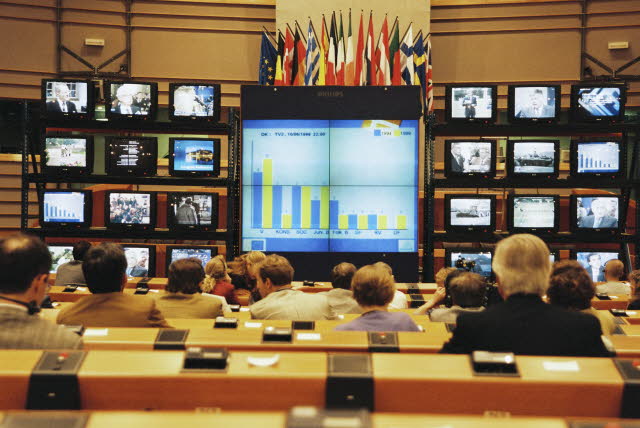
European Parliament. During the election evenings, projections of the composition of the new Parliament, based on latest available exit polls and estimates, will be presented to the media. As soon as voting is concluded in all EU countries, pan-EU results will be also made available. (EP Audiovisual Services, 14-05-2014).

European Parliament. During the election evenings, projections of the composition of the new Parliament, based on latest available exit polls and estimates, will be presented to the media. As soon as voting is concluded in all EU countries, pan-EU results will be also made available. (EP Audiovisual Services, 14-05-2014).

All mainstream political leaders of Europe in the socialist camp, the liberals and the center-right parties, invariably exorcise nationalism and populism, as the gravest threats to the EU project. They are quite right to do so. It’s not only the future of the EU which is at stake. Nationalism and populism already threaten the very democratic institutions within a number of European countries, with Hungary being the worst example. Elsewhere in Europe, and more importantly in core countries like France, Germany, England and Italy, some once marginal or recently hatched groups, are now ahead in public opinion polls or mark impressive ratings. Undeniably, the European elections of 22-25 May can turn out an ugly epitome of the current political reality. No wonder why everybody agrees that the entire political system of Europe is under heavy pressure that may worsen. However, many analysts indicate that the dangerous political off-springs of the economic crisis will gradually disappear when unemployment starts to recede. But the risk is that, in the between, the EU edifice, along with democratic institutions in some member states, may be seriously distressed or definitively afflicted. The three options that aren’t As Henri Malosse, the President of the European Economic and Social Committee solemnly puts it, three obvious options for Europe all lead to dead ends. Dissolving the EU and returning to inter-governmentalism means ending the European dream… or maintaining the status quo and keep semi-alive, semi-dead an incomplete Europe will soon lead to self-destruction and thirdly rushing ahead towards the federal model may prove fallacious. In this last case Malosse adds that, “Why would anyone agree to entrust more powers to institutions that have proved unable to listen to Europeans or take their views into account?” Of course Malosse has an answer. He proposes that “There is another way, however, that would involve using economic and social forces to identify and consolidate our common interests and, on that foundation, build policies that build mutual solidarity”. What he fails to say though is that, in order to mobilise the social and political forces needed for building policies which solidify mutual solidarity between the EU countries, the next European election has to turn out the necessary results. There are more ways to arrive at this conclusion, but in any case this European election is completely different and may hide unpleasant surprises. It’s not that this time the electorate has a say in choosing the next President of the Commission. A lot more than this is at stake. Not without good reason Malosse believes, that even the degradation of the EU into an intergovernmental affair, is a possibility. The egg of the serpent Undoubtedly then, this election may be incubating real threats for Europe coming from extremists of any kind, Eurosceptics, chauvinists, populists and harlequins. The risks are so great that the French President Francois Hollande felt obliged to warn his compatriots that an “Exit from Europe is exit from the history”. He actually wrote a desperate sounding article in “Le Monde”, only two weeks ahead of the European Elections. Hollande is badly cornered and faces a grave political challenge. Marine Le Pen, the leader of National Front extreme right, racist and Eurosceptic party, currently leading the race in polls, threatens to actually destroy the euro, by pulling France out from the euro area. Hollande is not alone to face grave political challenges. In Britain the Eurosceptic UKIP party of Nigel Farage also leads in polls, leaving the Conservatives of Prime Minister David Cameron in the third place behind the Labour Party. In Greece, the SYRIZA left wing political formation by questioning the value of euro shares the first place in polls with the governing New Democracy party of Prime Minister Antonis Samaras. In Italy the Five Star Movement under Beppe Grillo, a comedian in every respect, is only second to the governing Matteo Renzi’s Democratic Party. In Germany the newcomer Eurosceptic, Alternative for Germany gains momentum. No wonder why a lot of people in Brussels and the other core European capitals are quite alarmed. A hit below the belt from the US As if all that were not enough to put a lot of gray on Europe’s political future, the former US Treasury Secretary, Timothy Geithner, published this week a book tarnishing Europe’s recent political past. He says that George Papandreou and Silvio Berlusconi were both quite undemocratically forced by Brussels, Berlin and Paris to resign their premierships of Greece and Italy in November 2011. In reality, Geithner ‘reveals’ something that at the time every European intuitively understood and was widely discussed in the Press. Towards the end of 2011, both Papandreou and Berlusconi, in order to protect their personal political future, refused to apply the necessary unpopular economic measures needed to save their countries from bankruptcies. If Greece and Italy were to go bust, the then quite unprepared Eurozone, would have been briefly and uncontrollably disintegrated, with unpredictable consequences for all the other member states. Now Geithner found the opportunity, only days ahead of the European election, to denounce the ‘undemocratic practices’ of the European Union. The former US Treasury Secretary had also a few bad things to say about the first Obama administration he had served for many difficult years. He accuses the American President of making him say things he didn’t believe in. He forgets though to add that he could have resigned. In any case, Geithner is throwing stones to mainstream European politicians at a sensitive moment for the Old Continent, ahead of a crucial election. Understandably his motives seem quite dark. It works both ways Summing up all that, it becomes clear that this European election is crucial not only for the EU itself but for the entire world. It appears though, that from a more distanced point of view, this election despite the risks it contains and the problems it may produce, at the same time strengthens the feeling that the EU Peoples and countries are increasingly affecting each other. The 766 Members of the European Parliament would be elected for by more than 350 million of citizens of legal age. The intensive publicity though, over all those issues and the centrifuge tendencies seems to create a feeling, albeit week, that their vote will affect not only them and their country but other Peoples and member states too and the EU in its totality. It’s the first time that a European election acquires such a special significance and even the widespread disenchantment strengthens the feeling of ‘all in one boat’. All in all, the louder the clamor about the risks and the problems that this election may bring about, the clearer and clearer becomes the feeling of the special weight of the vote.  

Discover more from The European Sting - Critical News & Insights on European Politics, Economy, Foreign Affairs, Business & Technology - europeansting.com

Subscribe to get the latest posts sent to your email.

Interesting reads

© UNICEF/Oleksii Filippov A firefighter works on the balcony of a wrecked building in Kyiv, Ukraine.

World News in Brief: Russian attacks continue in Ukraine, Gazans shelter in flood-prone areas, keeping sight of eye health

This article is published in association with United Nations. UN human rights chief Volker Türk said on Thursday he was appalled by a wave of attacks that have killed civilians across Ukraine over the past four days.  They include a strike on two public buses in Kramatorsk on Thursday, that left at least 30 civilians dead, […]
This article is published in association with United Nations.

Ukraine: UN condemns latest attacks and calls for civilian protection

This article is published in association with United Nations. The UN Humanitarian Coordinator for Ukraine on Wednesday called for an end to attacks against civilians following further overnight strikes by Russian forces that reportedly killed at least 19 in the Chernihiv Region. Among the dead in Pryluky were five children, three of them babies, according to the […]
© UNICEF-SoP/Crickx People walk down a dusty road in the West Bank carrying belongings.

Israeli demolition in East Jerusalem displaces 69 Palestinians

This article is published in association with United Nations. Sixty-nine Palestinians – more than half of them children – were displaced on Tuesday after Israeli authorities green lit the demolition of their residential building in the At Tur area of East Jerusalem, the UN aid coordination office (OCHA) has reported. This is the highest number of […]
This article is published in association with United Nations.

‘The clock on AI regulation is ticking’, warns UN rights chief

This article is published in association with United Nations. The world is running out of time to put guardrails on artificial intelligence, UN High Commissioner for Human Rights Volker Türk warned Monday, as a “ruthless race” between companies and countries raises concerns about human safety and even humanity’s survival. Speaking in the UK at an AI […]
© UNOCHA/Alina Basiuk A school in Ukraine lies in ruins after being hit by a missile.

Ukraine war ‘a human rights catastrophe’ that must end, says Türk

This article is published in association with United Nations. Human Rights The war in Ukraine is a human rights catastrophe that is “growing and intensifying by the week” and threatening an even greater disaster across the region, UN High Commissioner for Human Rights Volker Türk said on Friday. Addressing the Human Rights Council in Geneva, Mr. […]
UN News Massive tent settlement of displaced residents extends along the damaged Gaza coastline.

Palestinians yearn for ‘a return to normal life’, says top Middle East peace envoy

This article is published in association with United Nations. The UN is continuing efforts to support Palestinians in Gaza amid major challenges to humanitarian access, reconstruction and the restoration of essential services, according to Ramiz Alakbarov, Acting UN Special Coordinator for the Middle East Peace Process. Speaking to UN News on the margins of the UN […]
©UNIFIL/Tilak Pokharel UNIFIL personnel distribute food kits to displaced families in Saida, Lebanon (file).

Lebanon: One in five children goes to bed hungry, says UNICEF

This article is published in association with United Nations. Four in five households in Lebanon struggle to afford basic necessities today, with children increasingly going without food, missing school and being pushed into work as conflict compounds years of economic crisis. “I wanted to buy clothes for my children, but I could not. I also wanted […]

World News in Brief: Deadly Myanmar strikes as Malaysia begins deportations, new emergency funding released, Gaza and West Bank update

The UN chief on Tuesday strongly condemned an airstrike that reportedly killed at least 50 people at a market in Myanmar’s Rakhine state and called for those responsible to be held to account. Forces from the military junta reportedly hit Kyauktaw township around midday on Monday, when the market’s more than 200 shops were busy […]
This article is published in association with European Investment Bank.

EU provides €61 million in humanitarian aid amidst rapidly deteriorating situation in Ethiopia

This article is brought to you in association with the European Commission. Amid fears of renewed conflict in Northern Ethiopia, the European Union is providing €61 million in humanitarian funding to help the most vulnerable people in Ethiopia affected by conflict, displacement, disease outbreaks and climate-related hazards, including the impact of El Niño. The European Union […]
© UNDP A worker installs solar panels in Lanao del Sur in the Philippines.

From energy crisis to energy transition: How renewables are reshaping energy security

This article is published in association with United Nations. The continuing conflict in the Middle East is disrupting global energy markets and pushing up fuel prices, with knock-on effects far beyond the region. For Francesco La Camera, Director-General of the International Renewable Energy Agency (IRENA), the crisis is also reshaping how the world understands the phrase […]
Countries adopted on Saturday a new global blueprint for tackling rapidly evolving forms of crime, as the UN’s largest gathering on crime prevention and criminal justice opened in Abu Dhabi with a call for stronger international cooperation. The Abu Dhabi Declaration was adopted by acclamation at the opening of the 15th United Nations Congress on Crime Prevention and Criminal Justice, bringing governments together around challenges ranging from cybercrime and fraud to the growing criminal exploitation of digital technology. The Declaration highlights an increasingly complex landscape in which services, infrastructure and technology can be exploited by criminals, including emerging trends described as “crime as a service” and “violence as a service”. At the same time, countries committed to making greater use of technology themselves, including by digitalizing justice systems and harnessing artificial intelligence in criminal justice responses. The Declaration stresses that safeguards must accompany those changes, including human oversight, transparency, due process and data protection. ‘Justice cannot be a privilege’ In a video message to the Congress, UN Deputy Secretary-General Amina Mohammed said the meeting was taking place at a time of profound change. “Justice cannot be a privilege. It must protect every person, uphold every person’s rights and leave no one behind,” said Ms. Mohamed. “This Congress is an opportunity to renew our shared commitment to justice and the rule of law, and to translate that commitment into action.” Countries are already being encouraged to put the Declaration into practice through the voluntary Pledge4Justice initiative, under which participating governments are announcing concrete, time-bound actions on crime prevention and criminal justice through 2031. The Abu Dhabi National Exhibition Centre with its curved glass tower and surrounding buildings reflected in calm water at dusk. UNODC The Abu Dhabi National Exhibition Centre where the 15th UN Crime Congress is set to take place. From Kyoto to Abu Dhabi Opening the Congress, UN Office on Drugs and Crime (UNODC) Executive Director Monica Juma framed the gathering as both a response to a changing criminal landscape and a test of international cooperation. “Today, the world convenes in Abu Dhabi to reaffirm that the rule of law and criminal justice are essential to the safety and security of people and the planet,” said Ms. Juma. “At a time when confidence in multilateralism is faltering, let Abu Dhabi be a testament to international cooperation.” Five years after the previous Congress in Kyoto, Japan, Ms. Juma said the world had reached another “inflection point”, with technology and artificial intelligence advancing at extraordinary speed. The same platforms connecting billions of people can also connect criminals, she warned, while digital currencies can conceal illicit profits and digital tools can be used to deceive, manipulate and exploit. Technology, she argued, is not simply accelerating crime but changing its character, while organized criminal networks increasingly exploit weaknesses across borders and institutions. Tweet URL Protecting people as the ‘north star’ Behind those broad trends, Ms. Juma urged delegates to focus on the people most exposed to harm, including children recruited by gangs, women facing violence at home or online, people unable to obtain legal assistance and young people lured into scam networks with promises of a better future. “Protecting these people must be the measure against which we judge our efforts over the coming week,” she said. “It must be our north star.” She called for laws and institutions capable of keeping pace with changing threats, greater access to justice and legal aid, and technology that serves as “a force for good” rather than an accelerator of harm. And while welcoming the Abu Dhabi Declaration as a starting point, Ms. Juma stressed that its impact would ultimately depend on implementation. A week focused on justice Hosted by the United Arab Emirates, the Congress runs through 1 October under the theme Protecting People and Planet in the Digital Age. Some 119 countries are represented, alongside more than 40 justice ministers and other senior officials, with over 5,100 participants from governments, civil society, academia and the private sector. Plenary meetings, workshops, side events and exhibitions will run throughout the session. Organizers are also billing this as the most youth-inclusive Crime Congress yet. Young people are participating in workshops, contributing to follow-up efforts and taking part in a dedicated Youth Lab and art exhibition, following a Youth Forum held ahead of the Congress on 24 and 25 September. UNODC serves as secretariat of the Congress and will support implementation of the Abu Dhabi Declaration.

Countries adopt global blueprint to tackle fast-evolving crime in digital age

This article is published in association with United Nations. Countries adopted on Saturday a new global blueprint for tackling rapidly evolving forms of crime, as the UN’s largest gathering on crime prevention and criminal justice opened in Abu Dhabi with a call for stronger international cooperation. The Abu Dhabi Declaration was adopted by acclamation at the […]
United Nations President Mahmoud Abbas of the State of Palestine addresses the General Debate of the UN General Assembly’s 81st session.

Palestinian existence under threat, Abbas tells UN, warning of ‘another Nakba’

This article is published in association with United Nations. Israeli policies now threaten “the very life and existence of the Palestinian people on their homeland”, Palestinian President Mahmoud Abbas told the UN General Assembly on Thursday, urging the world not to allow “another Nakba”.  Mr. Abbas addressed the Assembly’s annual debate via pre-recorded video after his […]
© UNICEF/Oleksii Filippov A rescue worker stands outside a residential building in Kyiv’s Solomianskyi district that was severely damaged during a massive overnight attack on the city.

World News in Brief: ‘New intensity’ to Russian attacks on Ukraine, Yemen, Gaza and Colombia updates

This article is published in association with United Nations. Russian armed forces have carried out repeated attacks across Ukraine over the past several days, killing and injuring civilians and damaging homes, hospitals, shops and workplaces, UN human rights monitors said on Thursday. The attacks have involved ballistic and cruise missiles, drones and guided aerial bombs. Between […]
UN Photo/Loey Felipe President Volodymyr Zelenskyy of Ukraine addresses the General Debate of the UN General Assembly’s 81st session.

Zelenskyy urges stronger pressure on Russia, warns war’s impact is spreading beyond Ukraine

This article is published in association with United Nations. Ukrainian President Volodymyr Zelenskyy on Wednesday called for intensified pressure on Russia to end its war against Ukraine, arguing that Moscow continues to incur massive losses while prolonging a conflict whose consequences are increasingly being felt far beyond the battlefield. Addressing the UN General Assembly’s annual debate, […]
UN Photo/Loey Felipe President Donald Trump of the United States addresses the General Debate of the UN General Assembly’s 81st session.

Trump defends military action against Iran, Venezuela, and calls for rebrand of AI

This article is published in association with United Nations. US President Donald Trump used his address to the UN General Assembly on Tuesday to defend recent military action against Iran, urging countries to maintain economic pressure on Tehran – and declaring that he now faces a choice between making a deal, or taking far more drastic […]
© UNICEF/Oleksii Filippov An injured girl climbs the partially collapsed stairwell of a building in Boryspil, Ukraine, following a missile strike.

‘Nowhere is safe’: UN experts detail Ukraine war’s toll and Russia’s reach beyond its borders

This article is published in association with United Nations. UN Human Rights Council-appointed experts on Monday laid out a grim picture of the human cost of Russia’s invasion of Ukraine, with a spotlight on civilians facing a third wartime winter as well as the intimidation of Russians who have fled abroad. The Independent International Commission of Inquiry […]
© UNICEF/Robic Upadhayay Aid workers transport supplies past a flood-damaged house in Nepal.

Nepal floods: ‘Apocalyptic’ destruction signals wider climate threat across Himalayas

This article is published in association with United Nations. The catastrophic flooding that swept away entire villages in northern Nepal could occur again in the country or elsewhere in the Himalayas due to climate change. The warning comes from Sara Netzer, regional director with UN field operations office UNOPS, which provides infrastructure, procurement and project management […]
This article is published in association with United Nations.

World News in Brief: Winter aid for Gaza, West Bank; Haiti food production; migrant deaths at sea; human rights funding

The UN Children’s Fund (UNICEF) is seeking to raise $97.5 million to protect 540,000 children and their families in Gaza and the West Bank from harsh winter conditions in the coming months. Nearly 84 per cent of Gaza’s population – more than 1.76 million people – live in overcrowded displacement sites or damaged shelters, leaving […]
© UNRWA Search-and-rescue operations continue following the collapse of a war-damaged building in Gaza city.

Gaza: At least 20 killed in deadly building collapse, search for survivors continues

This article is published in association with United Nations. Search and rescue operations continued in Gaza City on Wednesday following the collapse of a bombed-out building that killed at least 20 people, according to reports. The incident has highlighted the precarious situation of displaced Palestinians across the Gaza Strip who shelter wherever they can, including in […]

Why don't you drop your comment here?

Go back up

Discover more from The European Sting - Critical News & Insights on European Politics, Economy, Foreign Affairs, Business & Technology - europeansting.com

Subscribe now to keep reading and get access to the full archive.

Continue reading

Discover more from The European Sting - Critical News & Insights on European Politics, Economy, Foreign Affairs, Business & Technology - europeansting.com

Subscribe now to keep reading and get access to the full archive.

Continue reading

The European Sting – Critical News & Insights on European Politics, Economy, Foreign Affairs, Business & Technology – europeansting.com

