GAD, MAD, Evolutionary Traps and Other Evils of the Anthropocene Urging for Degrowth, Gradual Abandonment of Fossil Fuels and Limitation of our Ecological Footprint

(Credit: Unsplash)

This article was exclusively written for The European Sting by one of our passionate writers, Mr. Alexandros K. Liakopoulos. The opinions expressed within reflect only the writer’s views and not necessarily The European Sting’s position on the issue.


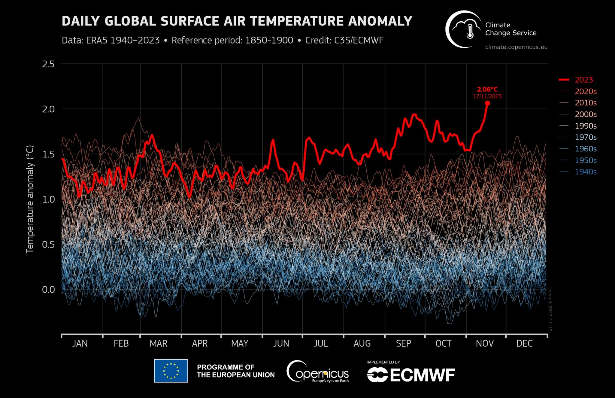
In less than a week the COP28 meeting starts its workings in Saudi Arabia, bringing together the global political and scientific leadership in its effort to mitigate the Climate Emergency in which we have found ourselves after 50 years of global inaction. The UN Emissions Gap Report 2023, titling “Broken Record”, states that “[the] world fails to cut emissions (again) [and] finds that the world is heading for a temperature rise far above the Paris Agreement goals unless countries deliver more than they have promised.” At odds with this report comes the IPCC’s Report of the UN, titling “Climate Change 2023: Synthesis Report”, which finds that “The report outlines that the 1.5°C limit is still achievable and outlines the critical action required across sectors and by everyone at all levels.” Obviously, something is not working quite fine with the IPCC’s models, while the month September has been the hottest month on record, hitting – and heating – an extraordinary 1,8 C above pre-industrial levels, while the 17th of November has also been the hottest day ever recorded in the last 125.000 years according to Copernicus – or in the last 3.000.000 years according to NASA – hitting 2.06 C above pre-industrial levels. Εικόνα που περιέχει κείμενο, στιγμιότυπο οθόνης
Περιγραφή που δημιουργήθηκε αυτόματα

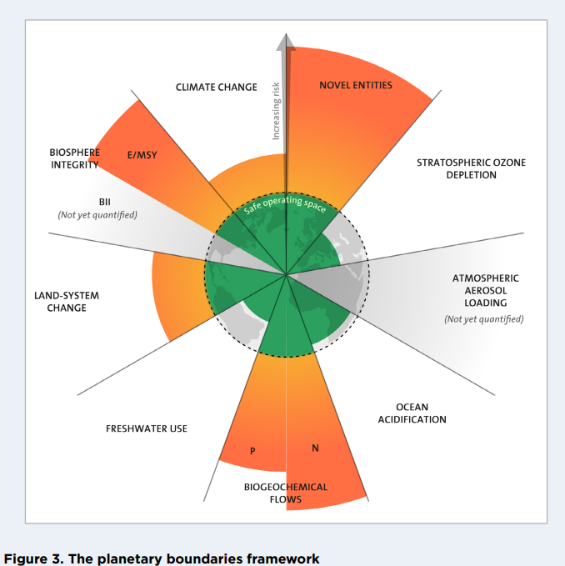
Other reports that have seen the light of publication while we head for the Global Stocktake Summit paint an even grimmer picture: the “State of Climate Action 2023” of the Systems Change Lab which brings together 8 different independent research institutions finds that we fail in 41 out of 42 parameters connected to CO2 emissions that they monitor each year. Their findings include the result/fact that we lose the equivalent of 15 football stadiums of forest per minute globally. To make things even worse, the report of the Post Carbon Institute’s title goes as follows: “Welcome to the Great Unravelling – Navigating the Polycrisis of Environmental and Social Breakdown” and finds that we have already exceeded 6 out of 11 planetary boundaries, we are at the verge of exceeding another 2, we do medium well in 2 and absolutely well only when it comes to atmosphere aerosol loading. However, this last is not that a nice thing that someone would imagine, Professor James E. Hansen, the so-called “father of Climate science” explains, as it reduces the formation of clouds that would reflect the incoming sunlight, leading to a massive uptick of the energy insertion to our atmosphere, which creates an Energy Imbalance. This Energy Imbalance – of an order of magnitude of on Watt per square meter, which is a huge number – further increases the heat of the planet, leading our planet to a future of an exponentially growing heating: it’s like we are into electro-waves already. Εικόνα που περιέχει κείμενο, στιγμιότυπο οθόνης, κύκλος, διάγραμμα
Περιγραφή που δημιουργήθηκε αυτόματαΕικόνα που περιέχει κείμενο, στιγμιότυπο οθόνης, διάγραμμα, σχεδίαση

Περιγραφή που δημιουργήθηκε αυτόματα

Dr. James Hansen et. al. have recently co-authored a paper arguing that “Global Warming [is] in the Pipeline”, where the scientists argue that “global warming will likely pierce the 1.5°C ceiling in the 2020s and 2°C before 2050. Impacts on people and nature will accelerate as global warming pumps up hydrologic extremes. The enormity of consequences demands a return to Holocene-level global temperature. Required actions include: 1) a global increasing price on GHG emissions, 2) EastWest cooperation in a way that accommodates developing world needs, and 3) intervention with Earth’s radiation imbalance to phase down today’s massive human-made “geo-transformation” of Earth’s climate.” In a follow-up paper of his titling “How We Know that Global Warming is Accelerating and that the Goal of the Paris Agreement is Dead”, to make his point even more clear, he states: “The proximate cause of ongoing global warming is Earth’s energy imbalance (EEI). Earth is now absorbing more energy incoming from the Sun than the planet is sending back to space as reflected solar light and emitted thermal (heat) radiation. As long as that imbalance is positive – more energy coming in than going out – Earth will continue to get hotter. Factors that alter Earth’s energy balance are called climate forcings. There are two large human-made climate forcings: changes of atmospheric greenhouse gases (GHGs) and changes of aerosols. GHGs reduce heat radiation to space; thus, an increase of GHGs causes a positive energy imbalance, more energy coming in than going out, which causes warming. Aerosols reflect sunlight to space, which is a negative contribution to EEI that causes cooling.” Due to all the above, the global warming is in the pipeline and we are heading for an accelerated heating: we ‘ll boil, the doctor essentially says. Εικόνα που περιέχει κείμενο, γράφημα, στιγμιότυπο οθόνης, γραμμή
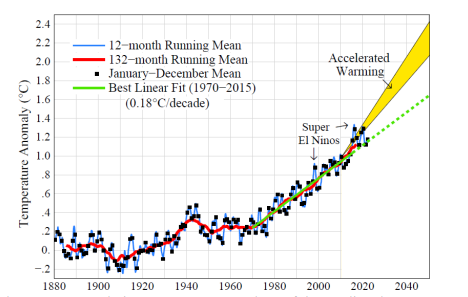
Περιγραφή που δημιουργήθηκε αυτόματα

To all the above parameters, one has to add our ecological overshoot. The ecological overshoot is calculated by the reduction of our ecological footprint as a species from the ecological capacity of the biosphere to sustain us, without counting any other species that is. Let’s say that it is only us, humans that are going to survive this century. What are the natural resources we need in order to feed ourselves and have enough water in order not die of thirst on the one hand, and what is the needed land that Gaia should use to recycle our wastes in order to sustain us in life? This is the question. According to the most accurate estimates of Dr. Bill Rees, specialist of the Ecological Footprint, the 2022 Ecological Footprint based on world population is 20.6 billion hectares, while Global Biocapacity based on remaining irrigated and arable land is 12.0 billion hectares. This means that Ecological Overshoot is 72%. Economic growth today is “financed,” in part, by the liquidation of nature — natural resources and ecosystems — and the destruction of global life-support systems. This is a living proof neoliberalism is a failed economic paradigm, which is philosophically a no-brainer argument: one cannot have infinite development in a finite planet, as neoliberal economic theory stipulates (see Samers, Simon, etc.).

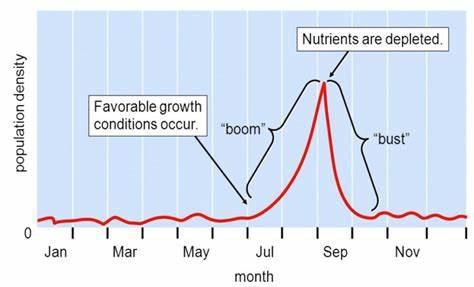
Should we not change the course we are heading, it will lead to Global Assured Destruction, aka GAD. As Ecological Footprints are exclusive environments and it is quite foreseeable that we humans will fight for the last arrable land to the end of days, it is also foreseeable that GAD will directly lead to MAD, mutually assured destruction through nuclear wars, kinetic wars, cyberwars, AI wars, or all of them together. What should not be expected is that the Last Men Standing will fall without some fights between them. History is quite indicative of how Homo Sapiens behave under extreme stress. And its ecosystem falling is expected to deliver him the most extreme stress ever, a shock no generation has ever faced in the past. In such circumstances we could opt for collaboration and engineering of the necessary solutions to save the more lives we can, as a population “bust” is also foreseeable after the long run of the “boom” we have been living during the last two centuries due to the fossil fuels energy, which created the imbalance between the positive and negative population feedback checks globally on the one hand, leading to population overshoot, and the overexploitation and degradation of nature as a result on the other. Now comes the time for us to pay the bill: the “bust” part of the cycle. Too Late for 2: September 2019
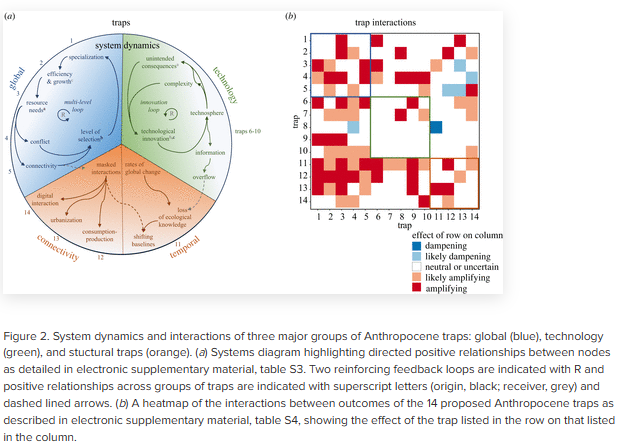
Further, the environment and nukes are not the only problems we are facing. In a recent paper published at the Philosophical Transactions of Royal Society B under the title “Evolution of the polycrisis: Anthropocene traps that challenge global sustainability”, the authors identify “14 [evolutionary] traps and categorize them as either global, technology or structural traps. An assessment reveals that 12 traps (86%) could be in an advanced phase of trapping with high risk of hard-to-reverse lock-ins and growing risks of negative impacts on human well-being. Ten traps (71%) currently see growing trends in their indicators. Revealing the systemic nature of the polycrisis, we assess that Anthropocene traps often interact reinforcingly (45% of pairwise interactions), and rarely in a dampening fashion (3%). We end by discussing capacities that will be important for navigating these systemic challenges in pursuit of global sustainability.”Εικόνα που περιέχει κείμενο, διάγραμμα, χάρτης, στιγμιότυπο οθόνης

Περιγραφή που δημιουργήθηκε αυτόματα

As it becomes apparent from all the above, we have entered an Era of Metacrisis, or Polycrisis, where what is politically possible will more and more be ecologically inadequate to produce any kind of meaningful result, if not lead directly to chaos and collapse, while what is urgently needed will seem like politically impossible. Strong leadership is more needed than ever, along with urgent decisions. The decisions have to comprise the following:

  1. Adoption of a degrowth paradigm and mentality. We need to “decapitalize our minds”, as Erin Remblance has brilliantly written: this is the key to addressing Climate Change. And the first who have to do it is world leaders. If not them, who? If not now, when? Fortunately, a new consensus have started to be forming towards this agenda, as it is the only sane choice remaining on the table, based not just on resilience, but on anti-fragility.

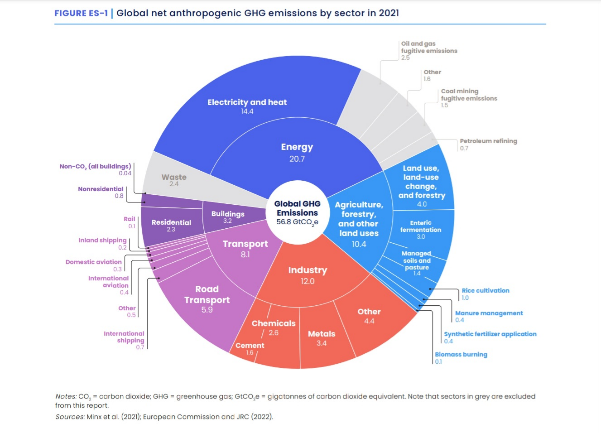
  2. Gradual transformation of our energy resources in the same time we make the Oil Barrons and Super Polluters pay for their share on our dark current predicament. A recent Oxfam study found that the richest 1% is responsible for 16% of global emissions, which equals the global emissions of the poorest 66% of the global population. So, taxing the super-rich heavily makes good sense. Then, these money should be used to assure global social justice and the gradual green transition, in parallel with other geo-engineering initiatives aiming to reduce the Energy Imbalance. Unavoidably, these initiatives have inherent risks, so we need to be careful; nevertheless, at the point we stand inaction is much worse than careful experimental action with heavy oversight of an international body under the auspices of the best minds the global community has. 

  3. Making war an impossibility: should war remain a possibility for states to solve their differences, all other solutions will fail, for sooner or later one desperate leader will opt for the worse, triggering all others’ response and leading the world to MADness before GADness even becomes a reality.

As leaders head for their meeting in UAE only some days after camels died there due to hail blizzards (!), let them have in mind that the world is watching them, while the world scientific community already knows what it expects in very large numbers: degrowth, reason, logic and cutting-throat decisions. Shortcuts and saving face just won’t do anymore.


Discover more from The European Sting - Critical News & Insights on European Politics, Economy, Foreign Affairs, Business & Technology - europeansting.com

Subscribe to get the latest posts sent to your email.

Interesting reads

This article is published in association with European Investment Bank.

EU provides €61 million in humanitarian aid amidst rapidly deteriorating situation in Ethiopia

This article is brought to you in association with the European Commission. Amid fears of renewed conflict in Northern Ethiopia, the European Union is providing €61 million in humanitarian funding to help the most vulnerable people in Ethiopia affected by conflict, displacement, disease outbreaks and climate-related hazards, including the impact of El Niño. The European Union […]
© UNDP A worker installs solar panels in Lanao del Sur in the Philippines.

From energy crisis to energy transition: How renewables are reshaping energy security

This article is published in association with United Nations. The continuing conflict in the Middle East is disrupting global energy markets and pushing up fuel prices, with knock-on effects far beyond the region. For Francesco La Camera, Director-General of the International Renewable Energy Agency (IRENA), the crisis is also reshaping how the world understands the phrase […]
Countries adopted on Saturday a new global blueprint for tackling rapidly evolving forms of crime, as the UN’s largest gathering on crime prevention and criminal justice opened in Abu Dhabi with a call for stronger international cooperation. The Abu Dhabi Declaration was adopted by acclamation at the opening of the 15th United Nations Congress on Crime Prevention and Criminal Justice, bringing governments together around challenges ranging from cybercrime and fraud to the growing criminal exploitation of digital technology. The Declaration highlights an increasingly complex landscape in which services, infrastructure and technology can be exploited by criminals, including emerging trends described as “crime as a service” and “violence as a service”. At the same time, countries committed to making greater use of technology themselves, including by digitalizing justice systems and harnessing artificial intelligence in criminal justice responses. The Declaration stresses that safeguards must accompany those changes, including human oversight, transparency, due process and data protection. ‘Justice cannot be a privilege’ In a video message to the Congress, UN Deputy Secretary-General Amina Mohammed said the meeting was taking place at a time of profound change. “Justice cannot be a privilege. It must protect every person, uphold every person’s rights and leave no one behind,” said Ms. Mohamed. “This Congress is an opportunity to renew our shared commitment to justice and the rule of law, and to translate that commitment into action.” Countries are already being encouraged to put the Declaration into practice through the voluntary Pledge4Justice initiative, under which participating governments are announcing concrete, time-bound actions on crime prevention and criminal justice through 2031. The Abu Dhabi National Exhibition Centre with its curved glass tower and surrounding buildings reflected in calm water at dusk. UNODC The Abu Dhabi National Exhibition Centre where the 15th UN Crime Congress is set to take place. From Kyoto to Abu Dhabi Opening the Congress, UN Office on Drugs and Crime (UNODC) Executive Director Monica Juma framed the gathering as both a response to a changing criminal landscape and a test of international cooperation. “Today, the world convenes in Abu Dhabi to reaffirm that the rule of law and criminal justice are essential to the safety and security of people and the planet,” said Ms. Juma. “At a time when confidence in multilateralism is faltering, let Abu Dhabi be a testament to international cooperation.” Five years after the previous Congress in Kyoto, Japan, Ms. Juma said the world had reached another “inflection point”, with technology and artificial intelligence advancing at extraordinary speed. The same platforms connecting billions of people can also connect criminals, she warned, while digital currencies can conceal illicit profits and digital tools can be used to deceive, manipulate and exploit. Technology, she argued, is not simply accelerating crime but changing its character, while organized criminal networks increasingly exploit weaknesses across borders and institutions. Tweet URL Protecting people as the ‘north star’ Behind those broad trends, Ms. Juma urged delegates to focus on the people most exposed to harm, including children recruited by gangs, women facing violence at home or online, people unable to obtain legal assistance and young people lured into scam networks with promises of a better future. “Protecting these people must be the measure against which we judge our efforts over the coming week,” she said. “It must be our north star.” She called for laws and institutions capable of keeping pace with changing threats, greater access to justice and legal aid, and technology that serves as “a force for good” rather than an accelerator of harm. And while welcoming the Abu Dhabi Declaration as a starting point, Ms. Juma stressed that its impact would ultimately depend on implementation. A week focused on justice Hosted by the United Arab Emirates, the Congress runs through 1 October under the theme Protecting People and Planet in the Digital Age. Some 119 countries are represented, alongside more than 40 justice ministers and other senior officials, with over 5,100 participants from governments, civil society, academia and the private sector. Plenary meetings, workshops, side events and exhibitions will run throughout the session. Organizers are also billing this as the most youth-inclusive Crime Congress yet. Young people are participating in workshops, contributing to follow-up efforts and taking part in a dedicated Youth Lab and art exhibition, following a Youth Forum held ahead of the Congress on 24 and 25 September. UNODC serves as secretariat of the Congress and will support implementation of the Abu Dhabi Declaration.

Countries adopt global blueprint to tackle fast-evolving crime in digital age

This article is published in association with United Nations. Countries adopted on Saturday a new global blueprint for tackling rapidly evolving forms of crime, as the UN’s largest gathering on crime prevention and criminal justice opened in Abu Dhabi with a call for stronger international cooperation. The Abu Dhabi Declaration was adopted by acclamation at the […]
United Nations President Mahmoud Abbas of the State of Palestine addresses the General Debate of the UN General Assembly’s 81st session.

Palestinian existence under threat, Abbas tells UN, warning of ‘another Nakba’

This article is published in association with United Nations. Israeli policies now threaten “the very life and existence of the Palestinian people on their homeland”, Palestinian President Mahmoud Abbas told the UN General Assembly on Thursday, urging the world not to allow “another Nakba”.  Mr. Abbas addressed the Assembly’s annual debate via pre-recorded video after his […]
© UNICEF/Oleksii Filippov A rescue worker stands outside a residential building in Kyiv’s Solomianskyi district that was severely damaged during a massive overnight attack on the city.

World News in Brief: ‘New intensity’ to Russian attacks on Ukraine, Yemen, Gaza and Colombia updates

This article is published in association with United Nations. Russian armed forces have carried out repeated attacks across Ukraine over the past several days, killing and injuring civilians and damaging homes, hospitals, shops and workplaces, UN human rights monitors said on Thursday. The attacks have involved ballistic and cruise missiles, drones and guided aerial bombs. Between […]
UN Photo/Loey Felipe President Volodymyr Zelenskyy of Ukraine addresses the General Debate of the UN General Assembly’s 81st session.

Zelenskyy urges stronger pressure on Russia, warns war’s impact is spreading beyond Ukraine

This article is published in association with United Nations. Ukrainian President Volodymyr Zelenskyy on Wednesday called for intensified pressure on Russia to end its war against Ukraine, arguing that Moscow continues to incur massive losses while prolonging a conflict whose consequences are increasingly being felt far beyond the battlefield. Addressing the UN General Assembly’s annual debate, […]
UN Photo/Loey Felipe President Donald Trump of the United States addresses the General Debate of the UN General Assembly’s 81st session.

Trump defends military action against Iran, Venezuela, and calls for rebrand of AI

This article is published in association with United Nations. US President Donald Trump used his address to the UN General Assembly on Tuesday to defend recent military action against Iran, urging countries to maintain economic pressure on Tehran – and declaring that he now faces a choice between making a deal, or taking far more drastic […]
© UNICEF/Oleksii Filippov An injured girl climbs the partially collapsed stairwell of a building in Boryspil, Ukraine, following a missile strike.

‘Nowhere is safe’: UN experts detail Ukraine war’s toll and Russia’s reach beyond its borders

This article is published in association with United Nations. UN Human Rights Council-appointed experts on Monday laid out a grim picture of the human cost of Russia’s invasion of Ukraine, with a spotlight on civilians facing a third wartime winter as well as the intimidation of Russians who have fled abroad. The Independent International Commission of Inquiry […]
© UNICEF/Robic Upadhayay Aid workers transport supplies past a flood-damaged house in Nepal.

Nepal floods: ‘Apocalyptic’ destruction signals wider climate threat across Himalayas

This article is published in association with United Nations. The catastrophic flooding that swept away entire villages in northern Nepal could occur again in the country or elsewhere in the Himalayas due to climate change. The warning comes from Sara Netzer, regional director with UN field operations office UNOPS, which provides infrastructure, procurement and project management […]
This article is published in association with United Nations.

World News in Brief: Winter aid for Gaza, West Bank; Haiti food production; migrant deaths at sea; human rights funding

The UN Children’s Fund (UNICEF) is seeking to raise $97.5 million to protect 540,000 children and their families in Gaza and the West Bank from harsh winter conditions in the coming months. Nearly 84 per cent of Gaza’s population – more than 1.76 million people – live in overcrowded displacement sites or damaged shelters, leaving […]
© UNRWA Search-and-rescue operations continue following the collapse of a war-damaged building in Gaza city.

Gaza: At least 20 killed in deadly building collapse, search for survivors continues

This article is published in association with United Nations. Search and rescue operations continued in Gaza City on Wednesday following the collapse of a bombed-out building that killed at least 20 people, according to reports. The incident has highlighted the precarious situation of displaced Palestinians across the Gaza Strip who shelter wherever they can, including in […]
UN News/Nargiz Shekinskaya The UN HQ (Secretariat) building in Manhattan.

The world comes to New York: What’s at stake at UN General Assembly high-level week

This article is published in association with United Nations. Each September, New York becomes the centre of global diplomacy as presidents, prime ministers, ministers and diplomats from around the world gather at United Nations Headquarters. At a time of mounting geopolitical tensions and overlapping global crises, leaders will tackle a packed agenda that includes conflicts and […]

Six UN staff killed in Gaza school strike; Lebanon violations mount

This article is published in association with United Nations. Israeli strikes killed six UN workers and civilians at a school sheltering displaced families in Gaza as needs grow, according to the UN agency for Palestine refugees, UNRWA. At least 220 agency staff have been killed in Gaza since the Hamas-Israel war began in October 2023. UNRWA Acting […]
This article is published in association with United Nations.

‘Where do we go?’: How Israel’s ‘yellow line’ is closing in on Palestinians

This article is published in association with United Nations. Ola Ishtiwi sits with her children in front of the remains of her home in the Al-Tuffah neighbourhood in eastern Gaza City, a few metres away from a series of painted cement blocks Israel has placed to mark what has become known as the “yellow line”. Initially set up following the announcement of the Israel-Hamas ceasefire […]
© UNDP/Oleksandr Ratushniak A substation in Ukraine damaged during ongoing strikes in the war with Russia.

Ukraine: Drone attacks on Chornobyl are ‘gambling with the safety of millions of people’

This article is published in association with United Nations. A drone strike on the protective structure at the Chornobyl Nuclear Power Plant could have endangered the safety of millions of people, UN Development Programme (UNDP) Administrator Alexander De Croo told reporters via video link from Kyiv on Thursday. He is visiting Ukraine, with his mission focused […]
© UNHCR/Dar Al Mussawir Smoke rises above residential neighborhoods in Tyre, southern Lebanon, following an Israeli airstrike. (file)

UN chief demands Israeli withdrawal from Lebanon amid Nabatieh escalation

This article is published in association with United Nations. The Secretary-General has condemned mounting civilian casualties in southern Lebanon and called on Israel to withdraw its forces from Lebanese territory, as fighting intensifies in and around Nabatieh. Key points In a statement issued by his Spokesperson, Stéphane Dujarric, the Secretary-General said he was “deeply concerned” by […]
© UNHCR/Dar Al Mussawir Smoke rises above residential neighborhoods in Tyre, southern Lebanon, following an Israeli airstrike. (file)

UN chief demands Israeli withdrawal from Lebanon amid Nabatieh escalation

This article is published in association with United Nations. The Secretary-General has condemned mounting civilian casualties in southern Lebanon and called on Israel to withdraw its forces from Lebanese territory, as fighting intensifies in and around Nabatieh. Key points In a statement issued by his Spokesperson, Stéphane Dujarric, the Secretary-General said he was “deeply concerned” by […]
© UNOCHA/Viktoriia Andriievska The aftermath of a drone strike in Kyiv, Ukraine (file). UN High Commissioner for Human Rights Volker Türk (file) said on Monday that he was "horrified" by the thought of fully autonomous weapons being used in battle.

AI: Türk urges action before it becomes an ‘existential risk to humanity’

This article is published in association with United Nations. UN human rights chief Volker Türk added his voice on Monday to growing calls for greater AI controls, warning that the revolutionary technology could become an “existential risk to humanity” if left unchecked. Without binding rules, independent oversight and clear limits, the technology could become impossible to […]
This article is published in association with United Nations.

As wildfires spread north, UN agencies race to help Europe adapt

This article is published in association with United Nations. As the climate warms, the threat of wildfires is spreading in Europe. How can historically cooler and wetter countries prepare? Human activity causes most of the wildfires breaking out across Europe, but their spread, speed and intensity are strongly affected by the warmer, drier conditions associated with […]

Why don't you drop your comment here?

Go back up

Discover more from The European Sting - Critical News & Insights on European Politics, Economy, Foreign Affairs, Business & Technology - europeansting.com

Subscribe now to keep reading and get access to the full archive.

Continue reading

Discover more from The European Sting - Critical News & Insights on European Politics, Economy, Foreign Affairs, Business & Technology - europeansting.com

Subscribe now to keep reading and get access to the full archive.

Continue reading

The European Sting – Critical News & Insights on European Politics, Economy, Foreign Affairs, Business & Technology – europeansting.com